
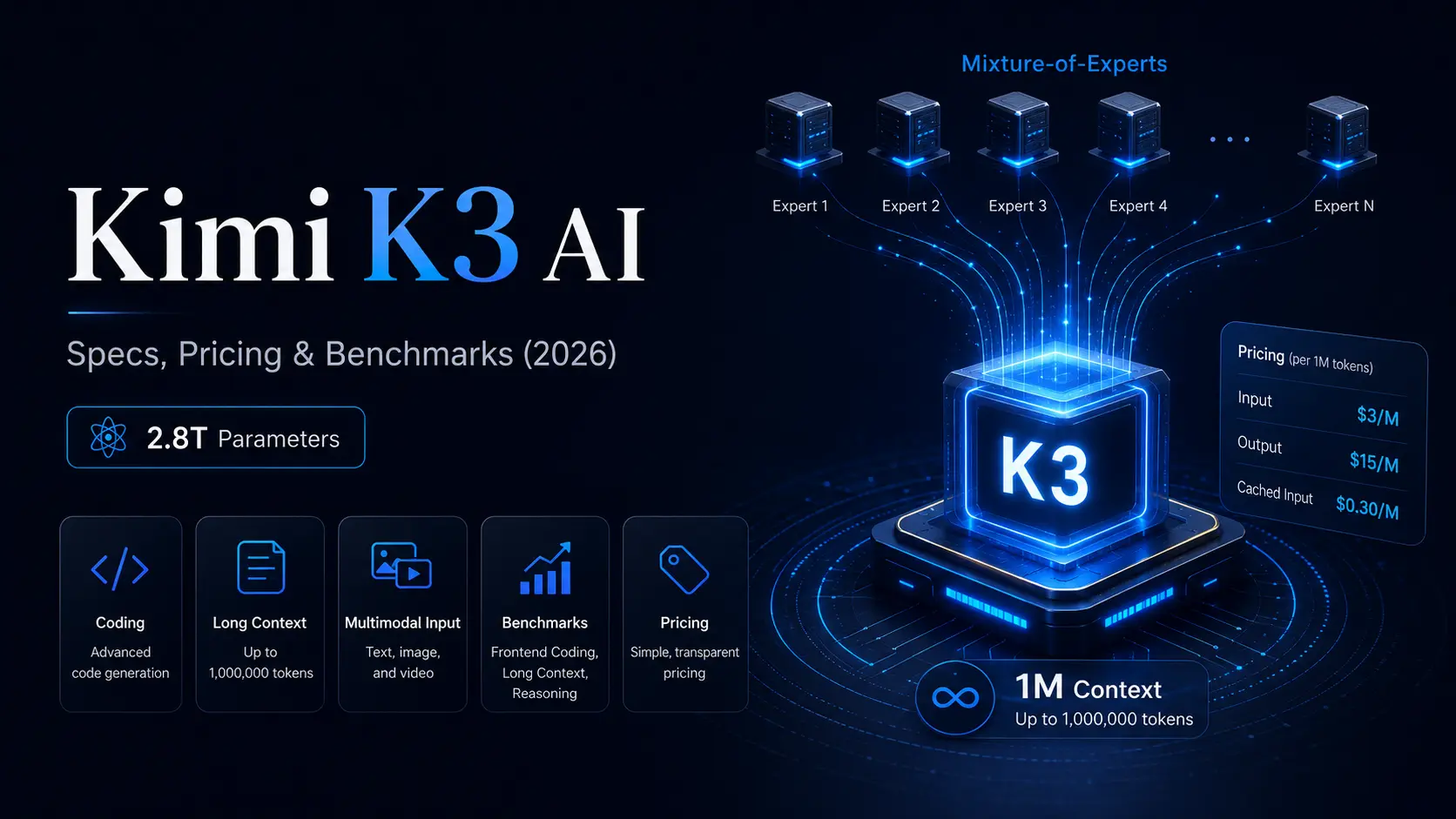
Moonshot AI released Kimi K3 on July 16, 2026, positioning it as its most capable model so far. The headline specifications are substantial: 2.8 trillion total parameters, a 1-million-token context window, native multimodal understanding, and an unusually sparse Mixture-of-Experts architecture.
Kimi K3 also reached first place on the Frontend Code Arena shortly after launch. However, it does not beat Claude Fable 5 or GPT-5.6 Sol across every evaluation, and its low per-token price does not always translate into a low final bill.
This Kimi K3 review separates verified specifications from launch marketing and examines its benchmarks, API pricing, cost per completed task, current open-weight status, and the best ways to access it.
What Is Kimi K3 AI?
Kimi K3 is a large multimodal reasoning model developed by Beijing-based Moonshot AI. It is designed primarily for long-horizon coding, agentic knowledge work, visual software development, research, and tasks involving very large amounts of context.
Moonshot describes K3 as the first open model in the three-trillion-parameter class. Its architecture activates only 16 of 896 experts for each token, allowing the model to use a small portion of its total parameter capacity at any one time.
Kimi K3 specifications at a glance
| Specification | Kimi K3 |
| Developer | Moonshot AI |
| Release date | July 16, 2026 |
| Total parameters | 2.8 trillion |
| Active experts | 16 of 896 |
| Context window | 1,048,576 tokens |
| Architecture | MoE, Kimi Delta Attention, Attention Residuals |
| Supported input | Text, images, and video |
| Output | Text |
| API model ID | kimi-k3 |
| Thinking modes | Low, high, and max |
| Default thinking level | Max |
| Full model weights | Scheduled by July 27, 2026 |
K3’s API accepts text, image, and uploaded video inputs, although its output remains text-only. It also has an always-on reasoning system: thinking cannot be completely disabled, but developers can reduce it by setting reasoning_effort to low.
Is Kimi K3 open source?
Not yet in the practical sense.
Moonshot has committed to releasing the full weights by July 27, 2026. Until those files and their final license are published, users cannot independently download, inspect, fine-tune, or self-host the full model.
Therefore, the most accurate description as of July 23 is:
Kimi K3 is an API-accessible model with a scheduled open-weight release.
Calling it fully open source is premature because model weights alone do not necessarily include the training data, complete training pipeline, or all production infrastructure. Artificial Analysis currently classifies K3 as proprietary because the weights are not yet available.
How Good Is Kimi K3? Independent Benchmarks and Limitations
Kimi K3 is a near-frontier model, but its performance is uneven. Its strongest results appear in frontend development, long-running agent tasks, and analytical knowledge work. Its main disadvantages are speed, token usage, and reliability.
Kimi K3 benchmark results
| Evaluation | Kimi K3 result |
| Frontend Code Arena | 1,679 Elo, ranked #1 at launch |
| Artificial Analysis Intelligence Index | 57, currently #4 of 186 |
| GDPval-AA v2 | 1,668 Elo |
| AutomationBench-AA | 53%, ranked #1 at launch |
| AA-Briefcase | 1,543 Elo, second behind Fable 5 |
K3’s first-place Frontend Code Arena result is significant because the leaderboard uses blind human evaluation rather than vendor-selected test cases. It reportedly ranked first in six of seven frontend categories, including design-oriented and reference-based interface work.
Artificial Analysis currently gives K3 an Intelligence Index score of 57. That places it among the leading models tested, but still behind the highest-performing proprietary systems. Its agentic knowledge-work performance is particularly strong: on AA-Briefcase, it ranked second behind Claude Fable 5 and ahead of GPT-5.6 Sol and Claude Opus 4.8.
Where Kimi K3 performs best
K3 is especially well suited to:
- Building and refining frontend interfaces
- Generating visually complex websites and interactive experiences
- Working across large repositories
- Long-running terminal and software-engineering tasks
- Research involving many documents and tool calls
- Spreadsheet, presentation, and analytical workflows
- Understanding screenshots, images, and uploaded video
Moonshot’s own evaluations also emphasize GPU programming, CAD, game development, visual software iteration, and scientific coding. These vendor-run demonstrations are useful examples, but they should not be treated as independent proof of general performance.
Kimi K3 limitations
It is slow. Artificial Analysis measured approximately 35.2 output tokens per second through Kimi’s first-party API, compared with a median of 70.5 tokens per second among similarly priced reasoning models.
It is verbose. K3 generated approximately 130 million output tokens during the Artificial Analysis Intelligence Index evaluation, compared with a median of 63 million. High token usage can increase both cost and completion time.
Reliability is not uniformly strong. On AA-Omniscience, K3’s measured hallucination rate was 51%, up from 39% for K2.6. This is a benchmark-specific result rather than a universal hallucination rate, but it indicates that high reasoning ability does not automatically guarantee factual reliability.
Long agent tasks may take too long. K3 averaged 56.4 minutes and 83 turns per task on AA-Briefcase, using roughly 120,000 output tokens per task.
Moonshot also warns that K3 can become unstable when a tool or agent framework fails to preserve its previous reasoning history. The model may also act too proactively when instructions are ambiguous, making decisions that the user did not explicitly request.
Kimi K3 Pricing: API Cost vs Cost per Task
Kimi K3 uses flat API pricing across its full 1-million-token context window.
| Token type | Price per 1M tokens |
| Cached input | $0.30 |
| Uncached input | $3.00 |
| Output and reasoning | $15.00 |
Context caching is automatic. Moonshot says its first-party API achieves cache-hit rates above 90% on coding workloads, although actual results depend on whether an application repeatedly sends the same prompt prefix or codebase context.
Is Kimi K3 actually cheap?
The answer depends on the task.
On the broad Artificial Analysis Intelligence Index, K3 averaged approximately $0.94 per task. That was similar to GPT-5.6 Sol at $1.04 and lower than Claude Opus 4.8 at $1.80. In that evaluation, K3 offered relatively strong capability for its completed-task cost.
However, on the more complex AA-Briefcase knowledge-work benchmark, K3 averaged $10.57 per task. Its high number of turns and output tokens made it more expensive than Opus 4.8 on that particular workload.
The accurate conclusion is not that K3 is always cheap or always expensive:
Kimi K3 has competitive token pricing, but its final cost depends heavily on reasoning length, agent turns, caching, and the type of task being completed.
Kimi membership pricing
Kimi currently lists four paid consumer plans:
| Plan | Monthly price | Agent credits |
| Moderato | $19 | 60 |
| Allegretto | $39 | 150 |
| Allegro | $99 | 360 |
| Vivace | $199 | 720 |
K3, K3 Swarm, website creation, slides, research, and other membership tools draw from a shared credit pool. Kimi Code also has separate rolling usage limits.
As of July 23, Kimi has temporarily paused new individual membership subscriptions while it expands computing capacity. Existing free or API access may still be available, but new paid subscription slots can be restricted.
Kimi K3 vs Claude Fable 5 and GPT-5.6 Sol
K3 should not be described as a universal winner. Each model has a different balance of price, speed, reliability, and task performance.
| Model | API input/output price | Main advantage | Main drawback |
| Kimi K3 | $3 / $15 | Frontend, long context, planned open weights | Slow and verbose |
| Claude Fable 5 | $10 / $50 | Highest overall capability and long-running agents | Expensive |
| GPT-5.6 Sol | $5 / $30 | Strong coding, polished deliverables, token efficiency | More expensive per token than K3 |
Claude Fable 5 remains ahead of K3 on several overall intelligence and knowledge-work evaluations. Anthropic prices it at $10 per million input tokens and $50 per million output tokens, with a 90% prompt-cache discount.
GPT-5.6 Sol costs $5 per million input tokens and $30 per million output tokens. OpenAI positions it as its flagship model for coding, agentic work, cybersecurity, and professional deliverables. It generally uses fewer tokens than K3 and performs particularly well when producing presentations and polished work products.
Which model should you choose?
Choose Kimi K3 when frontend quality, long context, multimodal understanding, or future self-hosting matters most.
Choose Claude Fable 5 when maximum overall capability and agent reliability matter more than price.
Choose GPT-5.6 Sol when you need strong coding combined with faster completion, better presentation quality, and more predictable token efficiency.
For production work, the best approach is to test each model on a small set of representative tasks rather than selecting one based entirely on leaderboard scores.
How to Access, Try, or Self-Host Kimi K3
Kimi K3 is currently available through:
- The Kimi website and mobile app
- Kimi Work for desktop workflows
- Kimi Code for terminal and IDE coding
- The Kimi API using the
kimi-k3model ID
The API is compatible with the OpenAI SDK through Moonshot’s custom base URL, making it relatively straightforward to connect K3 to existing applications and coding tools.
Can you self-host Kimi K3?
Not yet as of July 23, because the full weights have not been published.
Even after release, K3 will not be a typical desktop model. Moonshot says it uses MXFP4 weights and recommends deployment on supernode configurations with at least 64 accelerators. A simple four-bit calculation places the raw weight data at approximately 1.4TB before runtime overhead, caches, activations, routing data, and serving infrastructure are added.
That means full-scale self-hosting will initially be realistic mainly for AI infrastructure companies, research labs, and well-funded enterprise teams. Most individual developers will be better served by an API provider or future distilled versions.
Kimi K3 FAQ
Is Kimi K3 open source or open weight?
Moonshot plans to release the full Kimi K3 weights by July 27, 2026. As of July 23, the model is available through hosted products and APIs, but the weights and final license have not yet been publicly released.
How many parameters does Kimi K3 have?
Kimi K3 has 2.8 trillion total parameters. Its Mixture-of-Experts architecture activates 16 of 896 experts for each token.
What is the Kimi K3 context window?
Kimi K3 supports up to 1,048,576 tokens of context. The same flat API rates apply across the context window.
How much does the Kimi K3 API cost?
Kimi K3 costs $0.30 per million cached input tokens, $3 per million uncached input tokens, and $15 per million output tokens.
Can Kimi K3 generate images or videos?
No. K3 can understand text, images, and uploaded video, but it generates text output. To create a finished video from an image or prompt, you still need a dedicated AI Image to Video tool.
Kimi K3 is one of the strongest models Moonshot has released and one of the closest planned open-weight systems to the proprietary frontier. Its frontend performance, long-context capabilities, and agentic knowledge-work results are genuinely competitive.
Its weaknesses are equally important: it is slow, often verbose, expensive on some long-running workflows, and not yet available for self-hosting. K3 belongs on the shortlist for frontend development, large-context research, and organizations preparing for open-weight deployment—but it should be benchmarked on your own work before replacing Claude or GPT-5.6.