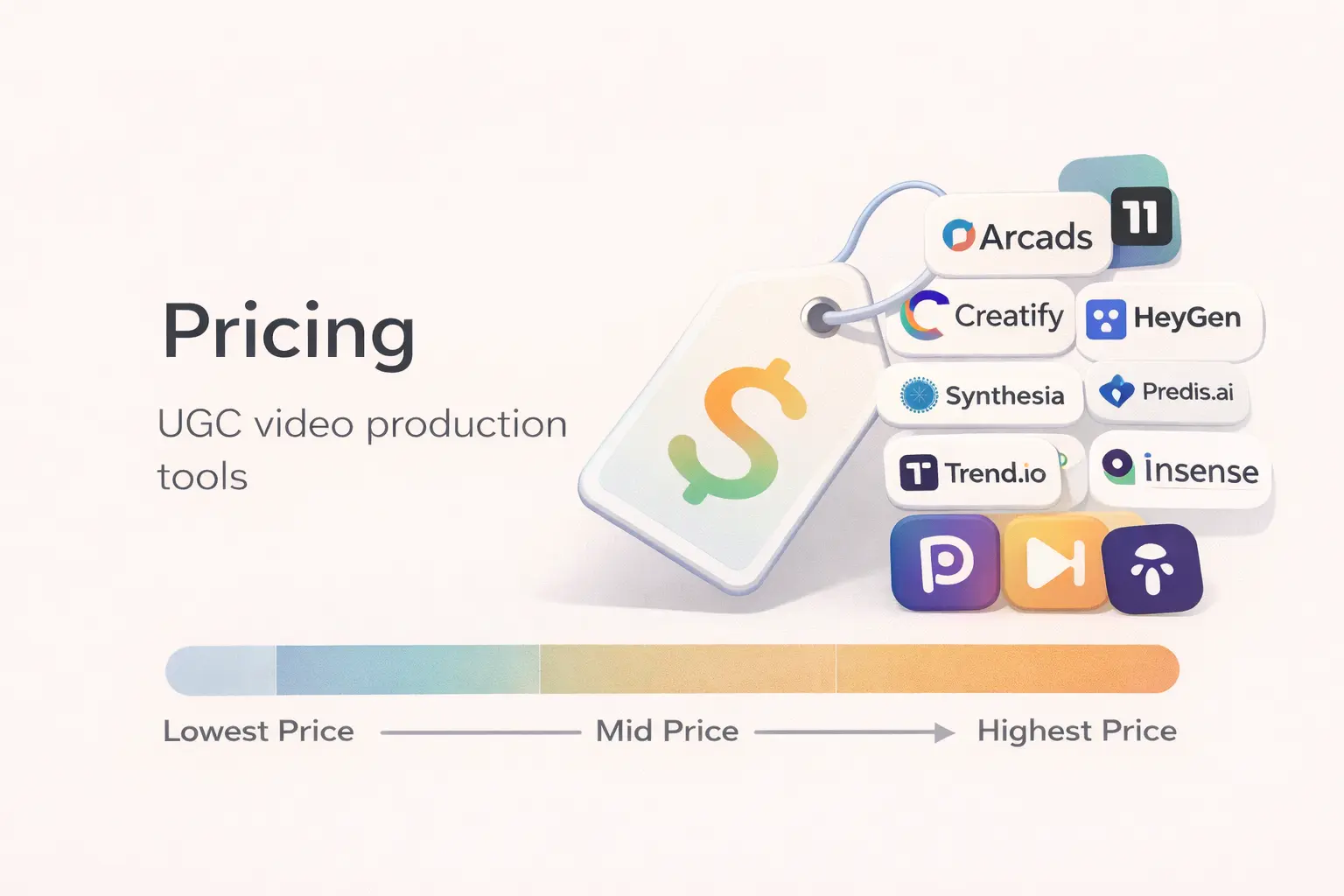
You’re paying $11 per AI-generated video while someone else gets the same quality for $0.54. The AI UGC tool market is a pricing maze—and most comparison articles are thinly veiled ads.
Here’s the problem: Marketers waste hours comparing tools across scattered sources, only to discover hidden credit costs and quality issues after subscribing. No single resource shows real per-video costs across all major platforms. You end up with spreadsheets, browser tabs, and still no clear answer.
This guide compares 10+ AI UGC video tools with transparent pricing, quality assessments, and honest community feedback—so you can match your budget to the right tool without the guesswork. We’ll cover everything from budget options at pennies per video to premium tools that cost more than a fancy lunch.
Why AI UGC Video Pricing Is So Confusing
The AI UGC market has a pricing transparency problem. Every tool uses a different model, making apples-to-apples comparisons nearly impossible without doing the math yourself.
The Three Pricing Models You’ll Encounter:
- Per-video pricing: You pay a flat rate for each video generated (e.g., $11/video). Simple to understand, but expensive at scale.
- Credit-based systems: You buy credits that deplete based on video length, quality settings, or features used. The actual per-video cost becomes a moving target.
- Subscription tiers: Monthly fees that include a certain number of videos or credits. The per-video cost depends entirely on how much you produce.
The Hidden Cost Problem:
What nobody tells you is that approximately 20% of AI-generated videos need regeneration. That AI avatar looked great in the preview but came out with a weird lip sync? That’s another credit burned. The script sounded natural when you wrote it but the delivery felt robotic? Regenerate. These hidden costs add up fast.
Traditional comparison articles fail because they list subscription prices without calculating the actual per-video economics. A $149/month plan sounds more expensive than a $49/month plan—until you realize one gives you 10 videos and the other gives you 100.
This article cuts through that noise. For every tool below, we’ll show you the real per-video cost, where it lands on the quality-price spectrum, and what actual users say about it. No affiliate-driven rankings. Just data.
Arcads
Arcads has positioned itself as the premium option in the AI UGC space, and its pricing reflects that ambition. At approximately $11 per video with monthly plans starting at $110+ for the basic tier, Arcads is frequently the most expensive option marketers encounter.
The per-video economics work like this: you’re paying for what Arcads claims is superior realism. Their AI avatars are designed to look and sound more natural than budget alternatives, with better lip sync and more convincing emotional delivery. For brands where authenticity matters—think health products, financial services, or anything requiring trust—that premium might be justified.
On the quality-price quadrant, Arcads sits firmly in the High Price / High Quality corner. You’re not paying for volume; you’re paying for videos that (theoretically) won’t make viewers immediately think “that’s AI.”
What the community actually says: Arcads pricing is a frequent topic on Reddit’s r/AI_UGC_Marketing and r/dropshipping communities. The consensus? It’s often criticized as expensive, but users who need quality acknowledge the output is among the best available. One common sentiment: “If you’re running high-stakes campaigns where a single good creative can justify the cost, Arcads makes sense. For testing 50 variations? Look elsewhere.”
Best for: Brands prioritizing quality over volume, established companies with proven products, campaigns where a single high-performing ad justifies premium creative costs.
Creatify
Creatify positions itself as the middle ground—better quality than budget tools without Arcads-level pricing. Their subscription model runs $49-$149 per month, translating to roughly $8-15 per video depending on your plan and usage.
The platform operates on a subscription basis, which means your per-video cost improves with volume. At the $149/month tier with heavy usage, you can push that per-video cost toward the lower end. Light users on the $49 plan will see higher effective costs.
Creatify lands in the Mid-High Price / High Quality quadrant. It’s positioned as the direct competitor to Arcads at a friendlier price point. The quality gap between the two has narrowed significantly in 2026, making Creatify an attractive option for marketers who want premium output without the premium price tag.
What the community actually says: Creatify vs Arcads comparisons dominate AI UGC discussions. The general verdict is that Creatify delivers 85-90% of Arcads’ quality at 60-70% of the price. Users particularly praise the avatar variety and the platform’s ease of use. Criticism tends to focus on occasional lip-sync issues and the learning curve for getting scripts to sound natural.
Best for: Mid-budget marketers who want quality without paying Arcads prices, agencies managing multiple client accounts, teams producing 10-30 videos monthly.
HeyGen
HeyGen has emerged as the value champion in the AI video space. With per-video costs around $1.50 and monthly plans ranging from $29-$89, it’s dramatically cheaper than the premium options while maintaining respectable quality.
The credit system works in your favor here. HeyGen’s generous credit allocations mean that even moderate users can produce significant volume without watching their costs spiral. The $89/month plan provides enough credits for dozens of videos, pushing your effective per-video cost well below $2.
On the quality-price quadrant, HeyGen occupies the enviable Low Price / Good Quality position. It’s not trying to compete with Arcads on realism—it’s trying to give you solid, usable AI videos at a price that makes sense for testing and iteration.
What the community actually says: HeyGen consistently receives praise for value. Users describe it as “the Honda Civic of AI video tools”—reliable, affordable, gets the job done without flash. The avatar quality is good enough for most use cases, though some users note the output can feel slightly more “corporate” than true UGC. Voice quality receives particular praise.
Best for: Budget-conscious teams needing volume, marketers prioritizing testing velocity over polish, businesses new to AI video who want to experiment affordably.
Synthesia
Synthesia takes a slightly different approach, positioning itself for professional and corporate content rather than raw UGC. At roughly $2.00 per video with plans from $29-$89 per month, the pricing is competitive with HeyGen.
The platform’s strength lies in its professional aesthetic. Synthesia avatars look polished, presentable, and corporate-appropriate. This makes it excellent for training videos, product explainers, and B2B content. For scrappy, authentic-feeling UGC? It’s less ideal.
Synthesia sits in the Low-Mid Price / Professional Quality quadrant. You’re getting reliable, consistent output that looks professional—just don’t expect it to pass as organic creator content on TikTok.
What the community actually says: Synthesia is frequently called the “corporate favorite” in AI video discussions. Enterprise users love the reliability and consistency. Marketers running D2C brands tend to find the output too polished—one Reddit user noted, “Synthesia videos look like they belong in a company training portal, not someone’s TikTok feed.”
Best for: B2B marketing teams, corporate training content, product demonstration videos, anyone who wants “professional” over “authentic.”
Predis.ai
Predis.ai has positioned itself as the all-in-one social media content engine with surprisingly capable AI UGC features. With pricing from $19-$212 per month on a credit-based system, it offers flexibility that appeals to both solo creators and scaling teams.
The economics favor content variety. Unlike pure UGC video tools, Predis.ai bundles AI avatar videos with ad creatives, social posts, and scheduling—meaning your subscription delivers value across multiple content types. For teams already producing static content who want to add UGC videos to their mix, the bundled approach can reduce overall tool sprawl.
Predis.ai occupies the Mid Price / Versatile Quality quadrant. The AI avatars are customizable by age, gender, and ethnicity, with natural-sounding voiceovers in multiple languages. The output quality sits between budget tools and premium specialists—good enough for social feeds, though perhaps not for hero ad campaigns.
What the community actually says: Predis.ai users praise the speed and convenience—generating UGC-style videos in minutes rather than hours. The platform’s strength lies in its end-to-end workflow: script generation, avatar creation, voiceover, and direct posting to social channels. Critics note that avatar realism doesn’t match dedicated UGC tools like Arcads, but the 10x speed improvement and integrated scheduling make it attractive for high-volume social strategies. Users report saving about 70% of time compared to traditional content creation methods.
Best for: Social media managers needing diverse content types, brands scaling multi-platform presence, marketers who want UGC capabilities bundled with broader content creation tools.
Trend.io
Trend.io takes a fundamentally different approach—it’s not an AI tool at all, but a marketplace connecting brands with real human UGC creators. With per-video costs averaging $69-$91 through package pricing starting at $550, it bridges the gap between AI-generated content and traditional creator partnerships.
The credit-based pricing works like this: Creator Credits cost approximately $9.16 each, with creators requiring 20-60 credits based on their skill level. Each hired creator delivers either 5 photos or 2 videos. The Scale package ($3,872) brings per-video costs down significantly through volume, while the Starter package ($550) offers an accessible entry point for brands testing human UGC without agency fees.
Trend.io sits in the Mid-High Price / Authentic Quality quadrant. You’re paying more than AI tools, but you’re getting real humans handling real products—something AI still can’t fully replicate.
What the community actually says: Trend.io is frequently recommended for brands where authenticity is non-negotiable. The “no subscription, no platform fees” model appeals to marketers burned by SaaS fatigue. Users appreciate that pricing is transparent—$50-$91 per video with no hidden costs. The main criticism? Turnaround time is days rather than minutes, and you’re dependent on creator availability. For brands comparing Trend.io against AI alternatives, the consensus is clear: “Use AI for testing and iteration, use Trend.io when you need the real thing.”
Best for: Brands requiring authentic human-created UGC, trust-sensitive product categories (health, finance, baby products), campaigns where the “AI detection” risk is unacceptable, marketers who want real product handling and genuine emotional delivery.
Higgsfield
Higgsfield has carved out a niche focused on motion quality. Their credit-based system with monthly plans from $19-$99 produces costs that vary by video complexity, but the platform is known for natural-looking avatar movement.
The value proposition is specific: if your ads rely on dynamic movement—product demonstrations, physical actions, gestures—Higgsfield’s motion algorithms outperform competitors. For talking-head content, you’re paying for capabilities you might not need.
Higgsfield positions in the Mid Price / High Motion Quality quadrant. It’s a specialist tool rather than a generalist.
What the community actually says: Higgsfield receives praise specifically for motion realism. Users producing fitness content, physical product demos, or anything requiring body language find it superior to alternatives. The learning curve is noted as steeper than competitors, and the avatar selection is smaller than HeyGen or Creatify.
Best for: Dynamic product demonstrations, fitness and lifestyle content, any creative requiring natural body movement.
Insense
Insense operates as a comprehensive creator marketplace platform, connecting brands directly with vetted UGC creators for authentic content production. With subscription plans ranging from $199-$999 per month, Insense positions itself as a scalable solution for brands needing consistent, high-quality human-created UGC.
The subscription model provides access to a curated network of creators, streamlined briefs and communication tools, and campaign management features. Unlike per-video pricing models, the monthly subscription covers platform access and creator matching—though creator fees are additional. The platform’s strength lies in its end-to-end workflow: from finding creators to managing deliverables and usage rights.
Insense sits in the Mid-High Price / Authentic Quality quadrant alongside Trend.io. You’re investing in real human creators with all the authenticity benefits that brings—genuine product handling, natural emotions, and content that won’t trigger AI detection concerns.
What the community actually says: Insense receives praise for its organized workflow and creator quality. Users appreciate the ability to build ongoing relationships with creators rather than one-off transactions. The platform’s brief system helps maintain brand consistency across multiple creators. Criticism typically centers on the monthly commitment—smaller brands may find the subscription model less flexible than pay-per-video alternatives. Marketers running sustained UGC campaigns often prefer Insense over managing individual creator relationships.
Best for: Brands with ongoing UGC needs, marketing teams wanting streamlined creator management, companies prioritizing authentic content at scale, agencies managing UGC for multiple clients.
ElevenLabs
ElevenLabs approaches AI UGC from a different angle—voice-first. Their premium voice synthesis technology costs approximately $44 for a 24-second ad, with monthly plans from $22-$99.
The per-video cost is high, but the voice quality is undeniably superior. ElevenLabs voices sound genuinely human in ways that most competitors can’t match. If your ad strategy depends on voice acting quality, the premium is justified.
On the quadrant, ElevenLabs occupies High Price / Premium Voice Quality. It’s a specialist tool for audio-focused creators.
What the community actually says: ElevenLabs voice quality receives universal praise—it’s frequently called best-in-class. The criticism is entirely about pricing and the fact that it’s primarily a voice tool being used for video. Users recommend it for voiceovers and audio-first content rather than full UGC video production.
Best for: Voice-first ad strategies, podcast advertising, any content where voice quality is the primary differentiator.
ugcjam
ugcjam takes the ultra-budget approach to its logical extreme. With pay-as-you-go pricing described as “pennies” per video, it’s targeting maximum volume at minimum cost.
The trade-off is obvious: at these prices, quality is basic. ugcjam is explicitly a quantity-over-quality play.
ugcjam sits in the Lowest Price / Basic Quality quadrant. It exists for marketers who want to test hundreds of concepts without financial risk.
What the community actually says: ugcjam reviews emphasize the economics over the output. Users describe it as “spray and pray” tooling—generate massive volume, find what resonates, then potentially recreate winners with better tools. Quality complaints are universal but accompanied by shrugs about the pricing.
Best for: Mass testing on minimal budgets, initial concept validation, marketers comfortable with low-quality output as a filtering mechanism.
MakeUGC
MakeUGC has entered the AI UGC space with a focus on simplicity and accessibility. The platform offers competitive pricing aimed at small businesses and individual creators who want to produce AI-generated UGC without a steep learning curve.
The pricing structure aligns with mid-market expectations, offering enough features for serious use while remaining accessible to smaller budgets. Quality output is consistent, though avatar variety is more limited than established players like HeyGen or Creatify.
What the community actually says: MakeUGC is still building its reputation. Early users praise the straightforward interface and quick generation times. Some note that the avatar library needs expansion, but the core functionality delivers on its promises.
Best for: Small business owners new to AI video, creators wanting simple workflows, marketers who prioritize ease of use over advanced features.
ezUGC
ezUGC lives up to its name with a platform designed for beginners. The pricing targets first-time AI video creators who want results without complexity.
The platform trades advanced features for simplicity. You won’t find granular controls or extensive customization, but you will find a workflow that gets you from script to video with minimal friction.
What the community actually says: ezUGC reviews highlight the learning curve—or lack thereof. Users who felt overwhelmed by competitors appreciate the streamlined approach. Power users find it limiting. The consensus: excellent for beginners, potentially frustrating for experienced marketers wanting control.
Best for: First-time AI video creators, marketers who want simplicity over features, businesses testing AI UGC with minimal time investment.
AI Image to Video
AI Image to Video takes a different approach to the AI video generation space, focusing on transforming existing images and text into video content. This makes it particularly valuable for marketers who already have strong visual assets and want to animate them.
The platform integrates multiple AI models including Kling, Veo, and Wan, giving users access to different generation styles and capabilities. Output quality reaches 4K resolution with no watermarks, and the batch processing support makes it practical for high-volume content creation.
The pricing positions competitively in the market, with the multi-model approach providing flexibility that single-model tools can’t match. If you’ve invested in product photography or have existing brand imagery, AI Image to Video lets you leverage those assets directly rather than starting from scratch with avatar-based generation.
What sets it apart: Unlike purely avatar-based tools, AI Image to Video excels at transforming static content—product photos, lifestyle imagery, brand assets—into dynamic video. This fills a gap that talking-head focused tools don’t address. The customizable controls for aspect ratio, video duration, and motion intensity provide granular creative control.
Best for: Marketers converting existing images to video ads, TikTok content creators needing quick turnaround, batch content production, anyone with strong visual assets wanting animation capabilities.
The Quality-Price Quadrant Summary
After analyzing all these tools, a clear pattern emerges. The AI UGC market has segmented into four distinct quadrants, and understanding where each tool sits helps you match your needs to your budget.
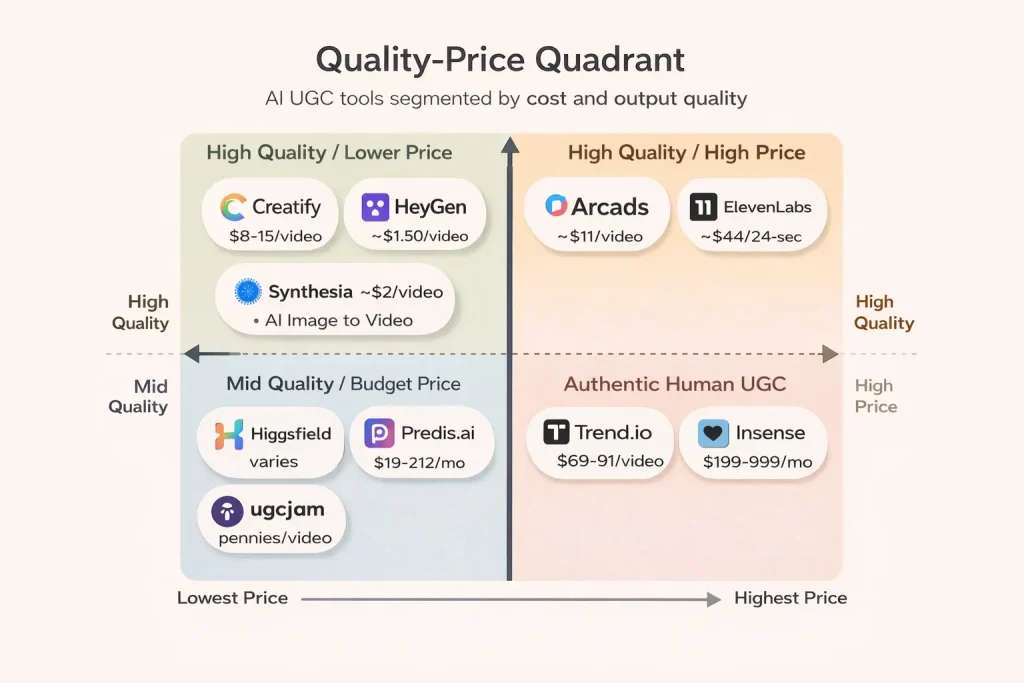
High Quality / High Price Quadrant:
- Arcads (~$11/video): Premium realism, best for high-stakes campaigns
- ElevenLabs (~$44/24-sec): Best-in-class voice, audio-focused strategies
High Quality / Lower Price Quadrant:
- Creatify ($8-15/video): Near-premium quality at mid-tier pricing
- HeyGen (~$1.50/video): Excellent value, versatile avatars
- Synthesia (~$2/video): Professional quality, corporate aesthetic
- AI Image to Video: 4K output, batch processing, multi-model flexibility
Mid Quality / Budget Price Quadrant:
- Higgsfield (varies): Specialized for motion quality
- Predis.ai ($19-212/mo): Versatile social content with UGC capabilities
Authentic Human UGC Quadrant:
- Trend.io ($69-91/video): Real human creators, authentic content
- Insense ($199-999/mo): Creator marketplace with managed workflows
Basic Quality / Lowest Price Quadrant:
- ugcjam (pennies/video): Maximum quantity, minimal cost
[Image: Quality-Price Quadrant diagram showing all tools positioned by their cost and output quality]
When each quadrant makes sense:
The premium quadrant works when individual creative performance directly drives significant revenue. If a single winning ad can generate thousands in sales, spending $11-$44 to create it is trivial.
The high-quality-lower-price quadrant is the sweet spot for most marketers. You’re getting professional output at sustainable costs, enabling both quality and reasonable volume.
The mid-quality-budget quadrant suits emerging brands and testing-heavy strategies. The output is usable, the costs are low, and you can iterate quickly.
The basic-quality-lowest-price quadrant is purely for volume testing. You’re not trying to create final ads—you’re trying to identify winning concepts before investing in better production.
Conclusion
The AI UGC video tool market in 2026 spans from $0.33 to $11+ per video, with no single “best” option for everyone. Your optimal choice depends on three factors: budget, volume needs, and quality requirements.
The key insights from this analysis:
- Premium tools like Arcads deliver superior quality but at costs that only make sense for high-stakes campaigns
- Mid-tier options like HeyGen and Creatify offer the best balance for most marketers
- Versatile platforms like Predis.ai bundle UGC with broader social content creation for teams managing multiple channels
- Human UGC marketplaces like Trend.io and Insense fill the authenticity gap when AI isn’t appropriate
- Specialized tools like AI Image to Video fill specific niches (image animation, batch processing) that generalist tools miss
The market is evolving rapidly. Pricing changes, quality improves, and new competitors emerge monthly. What’s expensive today may be commoditized tomorrow.
Call to Action: Start with free trials of your top 2-3 choices based on your budget quadrant. Test with real campaigns—not hypothetical scenarios—before committing to annual plans. The only way to know which tool fits your workflow is to use it. Most tools offer enough free credits or trial periods to make an informed decision.
If you’re specifically looking to animate existing product images or brand assets, explore AI Image to Video’s batch processing capabilities as a complement to avatar-based tools.