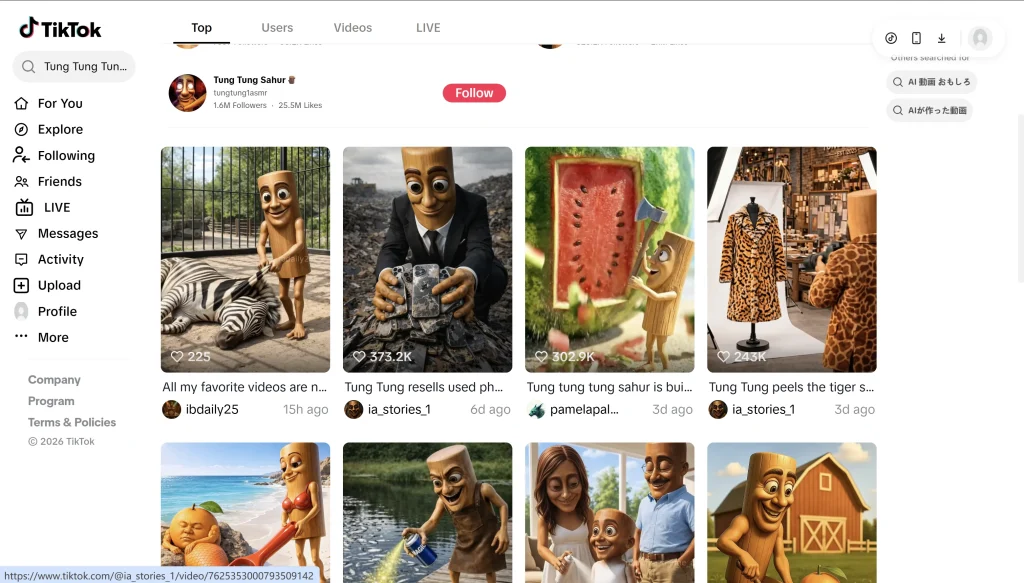
Have you seen those Tung Tung Tung Sahur AI videos on TikTok? They look weird, chaotic, and sometimes do not even make much sense, yet people cannot stop watching, reposting, and remixing them.
So why do videos like this blow up? And more importantly, how can you make this kind of TikTok video yourself? The truth is, production is no longer the hardest part. AI can already handle a lot of the visuals and editing. What matters more now is understanding why this style works in the first place, and how to turn that logic into a video people actually want to watch and share.
Why Do Some TikTok Videos Go Viral?
Some TikTok videos go viral not because they are polished, but because they are instantly recognizable, weird in a watchable way, and easy to remix. Formats like Tung Tung Tung Sahur work because viewers understand the character and tone within seconds, so there is almost no learning cost. The absurd visuals, dramatic delivery, and nonsense logic create just enough confusion to trigger curiosity and replays. At the same time, the format is highly reusable: creators can drop the same character shell into new scenes, jokes, and reactions. Once AI lowers production cost, that formula spreads fast.
How to Structure an AI TikTok Video That Feels Viral
Most AI TikTok videos that perform well follow a simple structure:
Clear character
Viewers should understand the character’s role from the first second, even if the design is strange or exaggerated.
Fast conflict
The tension should begin quickly, without too much setup or backstory.
Constant escalation
Each new beat should add surprise, pressure, or a stronger visual turn to keep people watching.
How to Write a TikTok Script That Actually Works
Start with a format, not a prompt
Weak AI videos often begin with a vague prompt and hope the visuals will do the work. Stronger ones begin with a clear format. Before writing anything, define the type of video you are making. The format gives the script its boundaries, pacing, and emotional direction. It tells you what kind of world the viewer is entering and what kind of payoff they should expect. Once that is clear, the writing becomes much easier to control.
Keep the premise simple enough to travel
A TikTok script should be built around an idea that can move fast. That does not mean the concept has to be shallow. It means the core setup has to be immediately legible. The viewer should understand who or what the video is about, what tension is driving it, and why they should stay for the next few beats. If the premise takes too much explanation, the video starts losing momentum before it even begins.
Write in beats, not in scenes
What works on TikTok is not a full screenplay. It is a sequence of clear, escalating beats. Each part of the script should give the viewer a reason to keep going: a reveal, a turn, a sharper emotion, a stranger image, or a stronger reaction. The point is not to explain everything. The point is to keep the story moving in a way that feels natural to short-form viewing. A good TikTok script creates momentum early, raises the stakes quickly, and ends before the idea runs out of energy.
Make every line visual
The script should be built for images first. Dialogue can help, but it should never carry the whole idea on its own. The strongest short videos are easy to follow even before the viewer fully processes the words. That is why good TikTok writing usually feels compressed, concrete, and visually direct. If a line cannot create an instant image, it is probably not doing enough work.
How to Make an AI TikTok Video (Step-by-Step)
Creating an AI TikTok video is not about chasing trends. It is about building a repeatable process you can scale. Below is a simple workflow you can follow to turn one idea into multiple videos.
Step 1: Choose a Reusable TikTok Format
Do not build your whole AI TikTok video around one meme. What matters more is finding a format you can use again and again. A repeatable structure is more valuable than a one-off idea because it lets you turn one successful post into a series.
Instead of focusing on a specific trend, think in formats: short drama, parody scenes, chaotic character stories, or fake cinematic moments. Formats last longer than memes and are easier to scale.
A good AI TikTok video format should be simple, repeatable, and easy to adapt into multiple variations.
Step 2: Define the Core Before Generating the AI Video
Many weak AI TikTok videos fail because they start generating too early. Before using any AI tool, get clear on three things: who the video is about, what tone it should have, and how the story moves from beginning to end.
These decisions shape the final output much more than tweaking random prompts. Once the character, tone, and structure are clear, the AI has something solid to work with.
Without this step, you are not really creating an AI TikTok video. You are just generating random clips and hoping one works.
Step 3: Generate Fast, Then Improve Key Moments
The first version of your AI TikTok video does not need to be perfect. A faster approach is to generate a rough cut, identify what already works, and then improve the most important moments.
In most cases, those moments are the opening, the main turning point, and the ending. If the hook is strong, the twist lands, and the ending triggers a reaction, the video will feel complete.
It is more effective to refine key moments than to over-optimize every second from the start.
Step 4: Package the AI TikTok Video for TikTok
A raw AI-generated video is not the final product. What makes it feel native to TikTok is the packaging layer: the opening text, captions, cover frame, and short description.
These elements help viewers quickly understand the video and decide whether to keep watching. Many AI TikTok videos fail not because the idea is weak, but because they stop at generation and never get properly packaged.
A well-packaged AI TikTok video can significantly improve watch time and engagement.
Common Mistakes When Recreating Viral TikTok Videos
Copying the meme instead of the format
A trending character may help in the short term, but it is rarely the real reason a video works. What makes a format repeatable is the structure behind it: a familiar shell, a simple conflict, fast escalation, and an ending people want to quote, comment on, or remix.
Making the script too complicated
If viewers need too much setup to understand the joke, the video loses momentum before it gets started. Viral TikTok videos usually work because the idea is easy to grasp within seconds.
Overvaluing polish and undervaluing watchability
Better visuals do not automatically lead to better performance. On TikTok, a weird but highly watchable video often spreads further than a polished one with no clear hook, tension, or payoff.
Conclusion
Technology is no longer the real barrier. Imagination is.
AI has made it much easier to generate scenes, create characters, test formats, and produce short videos quickly. What matters now is whether you can spot a format people instantly recognize, twist it into something surprising, and structure it in a way that keeps them watching. The recent spread of brainrot-style meme videos and Shaw-style AI parody shorts makes that clear: what travels is not just technical quality, but remixable ideas, sharp premises, and strong beat design.
If you really want to learn how to create a TikTok video, start there. Not with a perfect prompt. Not with a giant editing stack. Start with one clear format, one weird twist, and one story people will want to send to a friend.