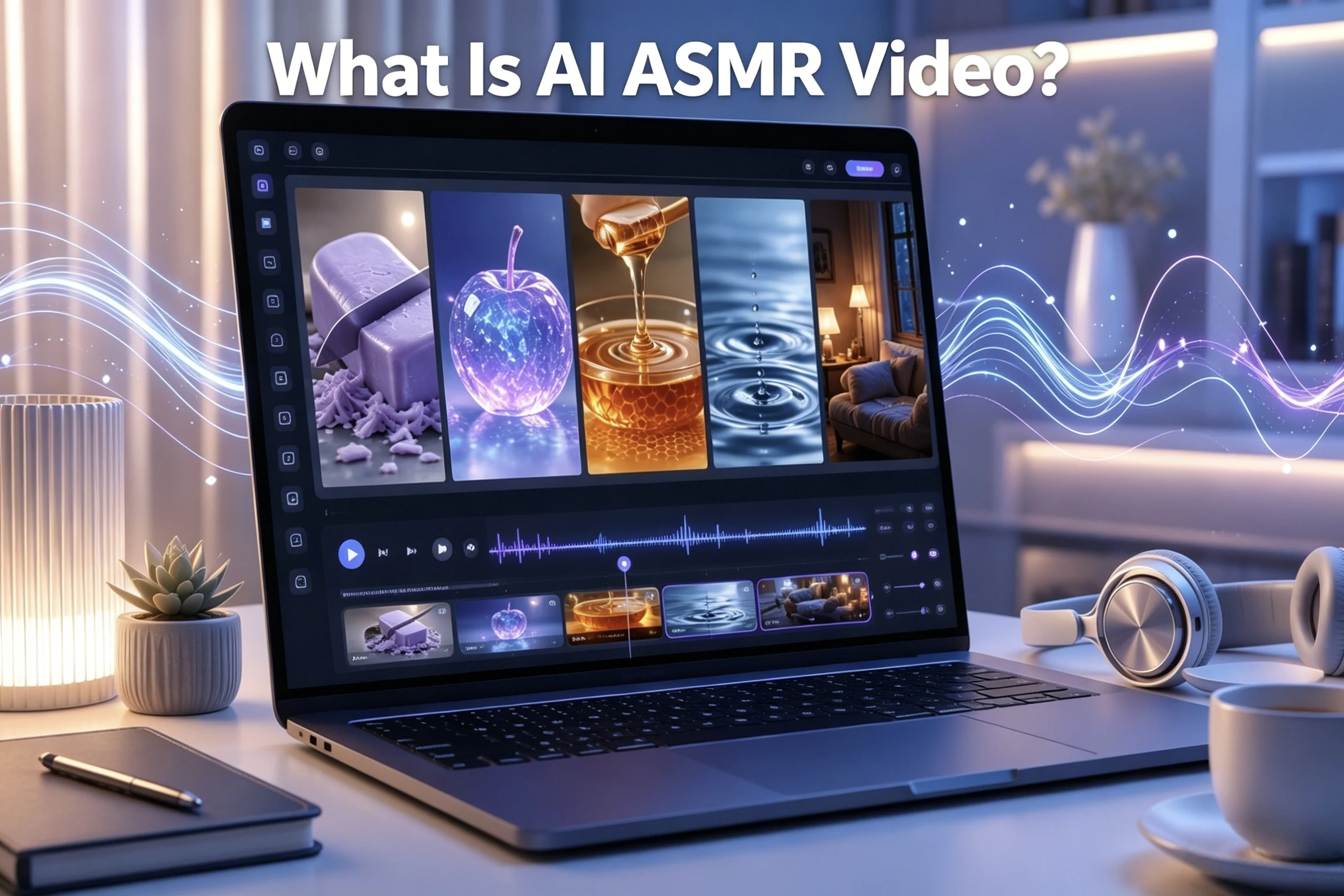
You are scrolling through TikTok before bed. A knife slices through a transparent glass banana with a crisp, satisfying crunch. It looks impossibly perfect — because it is. This is AI ASMR, and it is everywhere.
AI ASMR video is content that uses artificial intelligence to generate visually satisfying clips with synchronized sounds designed to trigger a relaxing, tingling sensation known as ASMR (Autonomous Sensory Meridian Response). Unlike traditional ASMR filmed with microphones and cameras, AI ASMR is created entirely through text prompts — no studio, no equipment, no face on camera. This guide walks you through the most popular formats, explains why these videos dominate short-form platforms, and shows you how to start creating your own.
How Do AI ASMR Videos Work?
Making an AI ASMR video is simpler than most people expect. The entire process starts with words — a text description of what you want to see and hear — and ends with a finished clip ready to publish.
From Text Prompt to Finished Video
The core workflow breaks down into three steps. First, you write a text prompt describing the scene, materials, actions, and sounds. Something like: “Macro close-up of a knife slicing a translucent glass apple on a marble surface. Crisp crunching sounds. Soft studio lighting. 4K.”
Second, an AI model processes that prompt and generates a short video clip — typically 5 to 15 seconds — with matching visuals and audio. Tools like Google Veo 3 produce both the video and synchronized sound in a single generation step, while other platforms may require you to layer audio separately.
Third, you edit the clips together, trim any visual artifacts, and publish. No camera, no microphone, and no prior video editing experience required to get started.
AI ASMR vs. Traditional ASMR Production
Traditional ASMR relies on physical equipment — specialized microphones ranging from $50 to $800+, a quiet recording space, and usually an on-camera presence. The creator whispers, taps, and crafts real sounds in real time.
AI ASMR collapses all of that into a text prompt and an AI tool. Traditional ASMR excels at personal, human connection — the intimacy of a real voice, the subtle imperfections of live sound. AI ASMR excels at creating physically impossible scenarios no real-world setup could produce: glass fruit, planets as sandwich spread, clouds being kneaded like dough. Both approaches serve different audiences, and both have a place in the broader ASMR world.
Popular Types of AI ASMR Videos
AI ASMR videos span a surprising range of formats. Here are the three categories that dominate feeds right now.
Glass Cutting, Soap Slicing, and Satisfying Object Transformations
This is the signature AI ASMR format. Transparent, glass-like objects — fruit, eggs, geometric shapes — get sliced, crushed, or peeled with exaggerated crisp sound effects. Soap shaving, kinetic sand compression, and crystal cracking fall into the same category.
These satisfying AI videos work because the materials and physics do not exist in reality. A single “Planet Spread on Toast” clip reached over 3.5 million views, and the format keeps expanding into more surreal territory — ice melting into gold, lava being kneaded, frozen matches snapping.
Food ASMR and Fantasy Kitchen Scenes
AI-generated food ASMR takes colorful candy crushing, chocolate pouring, and fruit slicing into surreal dimensions. The “Melty ASMR” format — featuring 3D AI fruit characters — racked up 11.1 million views in just seven weeks. Fantasy kitchens, alien ingredients, and oversized miniatures add visual novelty that real food ASMR cannot match. Since food ASMR is already one of the largest traditional ASMR categories, AI versions tap into a massive existing audience.
Nature Loops, Ambient Soundscapes, and Fantasy Rooms
The quieter side of AI ASMR generates rain on forest canopies, fireplace loops, ocean waves, and crackling campfires. Interactive poll formats like “Which dream bed would you choose?” and “Which fantasy pool would you dive into?” drive strong engagement — one such video pulled over 336,000 views.
These AI relaxing videos serve sleep, study, and meditation use cases, and jungle survival ASMR is emerging as a popular sub-niche.
Why AI ASMR Videos Are Trending on TikTok, YouTube Shorts, and Instagram Reels
AI ASMR is not just popular — it is algorithmically supercharged.
Short-Form Algorithms Love Satisfying Loops
TikTok, YouTube Shorts, and Instagram Reels algorithms reward high watch-through rates and replays. AI ASMR clips are typically 15 to 60 seconds of continuous, mesmerizing action — viewers watch to the end and often loop multiple times. This signals quality to the algorithm, pushing the content to more feeds.
TikTok’s #ASMR hashtag has surpassed 324 billion views, and the faceless, no-commentary format crosses language barriers effortlessly, reaching global audiences without translation.
The “Oddly Satisfying” Factor and Impossible Novelty
AI ASMR combines two powerful psychological triggers: the satisfaction of watching materials transform and the novelty of seeing physics that cannot exist in reality. This combination engages even viewers who do not experience traditional ASMR tingles.
The community phrase “I hate that I love this” captures the guilty pleasure effect perfectly. Some viewers do report discomfort or nausea from audio-visual mismatch — the brain receives conflicting sensory cues, creating a polarizing but high-engagement dynamic.
How To Create AI ASMR Videos as a Beginner
Ready to make your own? Here is how to get started with minimal experience and budget.
Choosing the Right AI Video Tool
Google Veo 3 is the current benchmark — it generates synchronized audio and video in a single step, making it ideal for AI ASMR. Kling AI offers a solid free-tier alternative with image-to-video animation, though generation wait times are longer. AI Image to Video is a beginner-friendly option that turns images and text into video content with customizable motion and output settings, supporting multiple AI models including Kling and Veo.
For voice-based ASMR, creators often pair a video generator with ElevenLabs for realistic AI whisper narration. The best tool depends on your format and budget — free options exist but may require more editing work.
Writing Prompts That Actually Work
A good AI ASMR prompt follows a simple template: [Shot type] of [subject/material]. [Key visual details]. [Action] in [speed]. [Lighting]. [Sound description].
For glass cutting: “Macro close-up of a knife slicing a translucent glass orange on a dark marble surface. Crisp crunching ASMR sounds. Soft cinematic lighting. 8K.”
For nature ambient: “Wide shot of rain falling on a lush jungle canopy. Gentle water droplets on broad leaves. Slow motion. Natural diffused light. Soft rain and distant thunder sounds.”
Keep prompts focused on a single short scene. Multi-scene descriptions are where AI consistency breaks down — and consistency between scenes is the biggest challenge in AI-generated video right now.
Editing and Publishing Your First Video
Compile generated clips in a free editor like CapCut or DaVinci Resolve. Trim any visual artifacts — morphing hands, physics glitches, changing object shapes between frames. Use 9:16 aspect ratio for TikTok, Shorts, and Reels; 16:9 for long-form YouTube.
Start with single-scene clips under 60 seconds. Add relevant hashtags (#ASMR, #satisfying, #oddlysatisfying) and publish. Your first video does not need to be perfect — it needs to exist.
Limitations, Ethics, and Quality Tips for AI ASMR Videos
AI ASMR has real limitations worth understanding before you invest time creating content.
What AI ASMR Still Gets Wrong
Audio-visual mismatch remains the biggest issue — sounds frequently do not match the materials shown. Visual artifacts like morphing fingers, changing object shapes, and inconsistent textures between frames break the immersive effect. Generating coherent long-form content (10+ minutes) is still extremely difficult. And despite what some tutorials claim, AI ASMR creation is not a “make viral videos in seconds” process.
Ethical Considerations for Creators
Always disclose AI use. YouTube’s July 2025 policy update requires AI content disclosure, and non-compliance risks demonetization. Never clone a real person’s voice without permission — the ASMR community has seen creators charging Patreon fees for AI voice content generated from others’ scripts without credit. Transparency builds trust; hiding AI use destroys it.
Tips for Higher-Quality AI ASMR Content
Focus on one format and master it before diversifying. Pay close attention to audio quality — for ASMR, sound matters more than visuals. Trim every glitchy frame rather than leaving artifacts visible. Keep notes on which prompts produce the best results, and study channels that perform well to understand pacing and format choices. Consider combining AI-generated visuals with real recorded sounds for a hybrid approach that feels more natural.
Frequently Asked Questions About AI ASMR Video
Can AI ASMR videos give you real tingles?
Some viewers report genuine tingles from AI-generated content, especially audio-focused formats with realistic whisper or ambient sounds. However, many traditional ASMR fans find that AI visual content triggers an “oddly satisfying” response rather than classic ASMR tingles. The experience varies by person and by format.
What is the best AI tool for making ASMR videos?
Google Veo 3 is widely considered the leading tool because it generates both video and synchronized ASMR audio in one step. For beginners on a budget, Kling AI offers a free tier, and AI Image to Video provides accessible image-to-video generation with support for multiple AI models. The best choice depends on your format and whether you need built-in audio.
Can you monetize AI ASMR videos on YouTube?
Yes, but YouTube’s policies require AI-generated content to be original, clearly disclosed, and not mass-produced. Since July 2025, YouTube’s Partner Program has tightened rules around AI content. Realistic ad revenue tends to be low — RPMs around $0.05 for global audiences. Many creators earn more from selling prompt packs and tutorials than from ads.
Is AI ASMR the same as regular ASMR?
Not exactly. Traditional ASMR relies on a real person creating sounds and visuals — whispering, tapping, personal attention — often building a human connection with the viewer. AI ASMR replaces the human element with generated content, excelling at visually spectacular or physically impossible scenarios but lacking the personal, intimate quality that many ASMR fans value.
Do I need video editing experience to make AI ASMR videos?
No. Most AI ASMR workflows start with a simple text prompt. Basic editing in a free tool like CapCut — trimming clips, adjusting volume — is helpful but not required for your first videos. Many creators publish single AI-generated clips directly to TikTok or YouTube Shorts with minimal editing.
Conclusion
AI ASMR video is AI-generated content designed to trigger relaxation and satisfaction through impossible visuals and synchronized sounds. From glass fruit cutting to fantasy nature loops, these videos thrive on short-form platforms because algorithms reward their looping, mesmerizing format. Beginners can start with accessible AI tools, a well-crafted prompt, and a free video editor.
If you have been curious about making AI ASMR content, the barrier to entry has never been lower. Pick a format, write a prompt, and publish your first clip. The best way to understand AI ASMR is to experience it — both as a viewer and as a creator.