Some AI videos feel like they were made by a genius. Others feel like a blender ate the internet and sneezed out a 5-second fever dream.
The strange part? Both can get views.
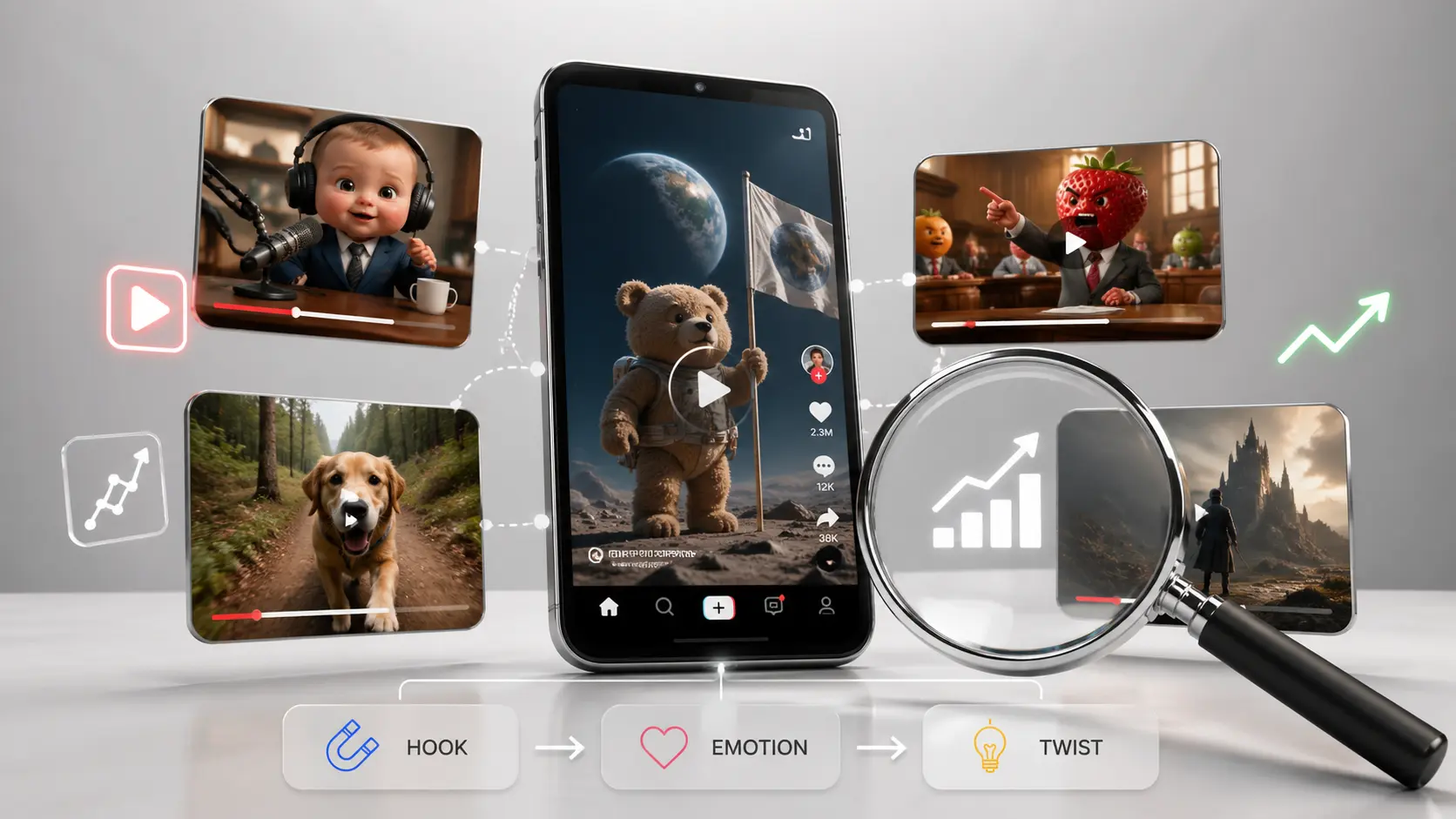
But the AI videos that went viral usually have more going on than “AI made something weird.” The best ones are not random accidents. They are built around a simple hook, a familiar format, a strange twist, and an emotion people instantly understand. A baby interviewing a dog. A fruit couple having a reality-show meltdown. A fake podcast guest saying something absurd. A tiny animal narrating its survival story like a Netflix documentary.
That is the real lesson for creators: viral AI videos are not just about better models, sharper pixels, or more realistic motion. They are about making people stop, understand, react, and share.
What Makes AI Videos That Went Viral Different?
Most people assume viral AI videos win because they look technically impressive. That is partly true, but only partly. A clean video helps. Stable motion helps. Good lighting helps. But technical quality alone rarely makes people comment, remix, duet, or send a video to a friend with “why am I watching this?”
The AI videos that went viral usually do three things very quickly. They show something viewers already recognize, then make it impossible, then give the audience a reason to react. That combination is powerful because it removes friction. People do not need a long explanation. They get the joke or the drama immediately.
A talking strawberry in a courtroom works because we already understand courtroom drama. A baby in a podcast setup works because we already understand podcasts. A raccoon filming a survival vlog works because we already understand first-person adventure videos. The AI part makes the scene impossible, but the format makes it easy to follow.
That is the sweet spot.
The First 3 Seconds Matter Most
In short-form video, the first three seconds are not an introduction. They are the test.
A weak opening says, “Please wait, something interesting might happen later.” A strong opening says, “You already know what is happening, and it is weird enough to keep watching.”
For viral AI videos, the opening frame often does most of the work. Think of a baby sitting behind a giant podcast microphone. A banana crying in a courtroom. A cat wearing a bodycam while running from a vacuum cleaner. These images make a promise before the video even moves.
That matters because AI video still has limits. Some clips may have strange hands, odd motion, or inconsistent details. A strong hook gives viewers a reason to forgive small flaws. If the idea is funny enough, people will not pause the video to complain that the banana’s shadow is slightly wrong.
For creators using an AI image to video generator, this is why the still image matters so much. AI Image to Video supports image-based generation, text-based generation, and combined image + text prompting, which gives creators more control over the opening visual before adding motion.
Impossible but Easy to Understand
The best viral AI video ideas are impossible, but not confusing.
“An orange finds out a mango is not the father of her baby tangerine” is absurd, but the structure is familiar: paternity test drama. “A baby explains corporate layoffs in a podcast voice” is impossible, but the contrast is obvious: tiny cute face, adult serious topic. “A dog gives a first-person report while escaping bath time” is silly, but everyone understands the stakes.
Bad AI videos often fail because the weirdness has no shape. A glowing alien deer floating through a supermarket while a clown chef turns into a castle might look strange, but what is the viewer supposed to feel? Surprise? Confusion? A headache?
Viral weirdness needs a handle. The audience should be able to describe the video in one sentence:
“It’s a baby running a podcast.”
“It’s fruit acting like reality TV stars.”
“It’s an animal filming its own disaster.”
“It’s a fake interview with someone who should not be there.”
If viewers cannot explain it quickly, they are less likely to share it.
Emotion Beats Perfect Realism
A lot of creators obsess over realism. They want the face to be perfect, the camera movement to be cinematic, and every frame to look expensive. That can help, especially for cinematic AI mini-movies. But most viral AI videos do not go viral because they are flawless. They go viral because they trigger emotion.
The emotion can be laughter, shock, curiosity, secondhand embarrassment, cuteness, fear, or even anger. The important thing is that the viewer feels something fast.
This is why exaggerated AI videos often beat polished but empty ones. A slightly messy AI baby rant can outperform a beautiful AI landscape because the baby has personality. A low-budget-looking fruit drama can outperform a perfect fantasy scene because the fruit drama has conflict.
Viral AI video is closer to meme-making than traditional filmmaking. The question is not only “Does this look real?” It is “Will someone react?”
Popular Types of AI Videos That Went Viral
The internet does not reward one single AI video style. Different formats go viral for different reasons. Some rely on cuteness. Some rely on absurd drama. Some rely on suspense. Some rely on the uncanny feeling that makes viewers ask, “Wait, is this real?”
Here are the major formats creators can learn from.
AI Fruit Microdramas
AI fruit videos are one of the clearest examples of how viral AI content borrows from existing entertainment formats. These clips often use anthropomorphic fruit characters, dramatic relationships, betrayal, courtroom scenes, dating-show setups, or reality-TV-style confrontations.
The appeal is easy to understand: fruit is harmless and cute, but the storylines are dramatic and messy. That contrast creates instant absurdity. WIRED reported on viral AI fruit dramas such as “Fruit Paternity Court” and “Fruit Love Island,” noting both their rapid spread and the darker ethical concerns around some violent or humiliating storylines.
For creators, the lesson is not “make more fruit drama.” The lesson is format transfer. Take a familiar entertainment format, replace the human cast with impossible AI characters, and keep the story simple enough to understand in seconds.
A safer, more brand-friendly version could be:
“Two coffee cups arguing over who got replaced by matcha.”
“A sad lemon going to therapy after being squeezed.”
“A tomato influencer getting canceled for pretending to be a fruit.”
The format works because the audience already knows the emotional language.
AI Baby Celebrity Videos
AI baby videos often go viral because they combine cuteness with adult behavior. A baby talking like a podcast host, CEO, sports analyst, or celebrity interviewer creates a sharp contrast. The viewer understands the joke before the first sentence ends.
But this format needs care. If the video uses real celebrities, real voices, or realistic likenesses, creators should think about consent, parody, disclosure, and platform rules. TikTok requires creators to label AI-generated content that contains realistic images, audio, or video, and YouTube also asks creators to disclose realistic altered or synthetic content during upload.
A safer approach is to create fictional characters with clear parody framing. Instead of “AI baby version of a real celebrity saying things they never said,” try “tiny CEO baby explains why naps should be paid time off.” The comedy stays, but the risk drops.
AI Animal POV Stories
AI animal POV videos are powerful because they turn everyday pet behavior into epic drama.
A dog running from a bath becomes a prison escape. A cat knocking over a cup becomes a spy mission. A squirrel crossing the road becomes a survival documentary. The AI makes the camera angle impossible, but the behavior feels familiar.
This format works especially well for short-form platforms because it has built-in motion. Running, hiding, jumping, sniffing, staring, escaping—animals naturally create action. Add first-person narration or subtitles, and the video becomes a tiny story.
For AI Image to Video creators, this is a strong format because one clear starting image can become many variations. A single still image of a raccoon near a trash can can turn into a chase scene, a confession video, a fake news report, or a “day in my life” mini vlog.
Fake AI Interviews
Fake AI interviews are everywhere because the format is instantly recognizable. Podcast table. Microphones. Two-shot framing. Serious lighting. Then the impossible guest appears.
The viral hook often comes from contrast. A toddler gives financial advice. A dog explains why he ate the couch. A dinosaur talks about extinction like it was a bad breakup. A robot complains about being replaced by newer AI.
The best fake AI interviews do not need long scripts. In fact, shorter is usually better. One question, one ridiculous answer, one facial reaction, done.
The danger is making the video too dependent on dialogue. If nothing interesting happens visually, the clip can feel like a talking-head meme with AI decoration. Add a strong reaction, a visual prop, or a quick twist at the end.
Cinematic AI Mini-Movies
Cinematic AI mini-movies are the opposite of low-effort meme clips. They use dramatic lighting, carefully composed shots, emotional music, and a small story arc. These videos often feel like trailers for a movie that does not exist.
This format works well when the viewer can sense a bigger world quickly. A lonely astronaut finding a flower on Mars. A robot child walking through an abandoned city. A tiny dragon hiding under a kitchen table. The video does not need to explain everything. It only needs to make people want the rest of the movie.
The challenge is that cinematic AI videos can become beautiful but forgettable. To avoid that, creators need a strong story question:
Who is in danger?
What changed?
What is the impossible discovery?
What emotion should the viewer leave with?
Cinematic polish should support the hook, not replace it.
Faceless AI Story Videos
Faceless AI story videos are popular because they are scalable. Creators can combine narration, AI visuals, captions, and music without appearing on camera. This is attractive for people who want to publish consistently without filming themselves.
Common formats include mystery stories, “what if” scenarios, fake historical scenes, scary bedtime stories, motivational shorts, and fictional diary entries. The AI visuals do not always need perfect realism. They need to match the mood and keep the viewer moving from one beat to the next.
For SEO, TikTok, Reels, and YouTube Shorts creators, this format is useful because it can become a repeatable series. A faceless channel can build around “AI animal survival stories,” “AI alternate history clips,” or “AI tiny horror stories.” The repeatable promise matters more than any single clip.
The Hidden Pattern Behind Viral AI Videos
When creators ask how to make viral AI videos, they often look for secret prompts. Prompts help, but they are not the whole answer.
The hidden pattern is usually structural. Viral AI videos combine a familiar container with a strange subject, then add conflict and a comment-worthy twist. That structure makes the video easy to understand and easy to talk about.
Familiar Format, Strange Subject
This is the most important pattern.
A familiar format gives the viewer context. A strange subject gives the viewer surprise.
Examples:
Podcast + baby
Reality show + fruit
Nature documentary + house cat
Courtroom drama + vegetables
Security camera footage + ghosts
Cooking tutorial + alien ingredients
News report + talking dog
The format tells viewers how to watch. The strange subject tells them why this version is worth watching.
This is also why “AI video trends” often move in clusters. Once one format works, creators copy the container and swap the subject. Trend roundups commonly track formats such as AI avatars, surreal loops, talking photos, and cinematic prompt-made videos because these are repeatable structures, not just isolated clips.
Clear Conflict or Reaction
A viral AI video needs tension. It does not have to be serious tension. It can be silly, tiny, or fake. But something should be happening.
Conflict can be simple:
The baby is angry.
The fruit is exposed.
The cat is guilty.
The dog is terrified.
The alien is confused.
The robot is jealous.
Reaction is just as important. Many AI videos fail because they show an event but no emotional response. A giant donut falls from the sky. Fine. But who reacts? A police officer? A child? A raccoon news reporter? The reaction gives the audience permission to feel something.
A strong reaction can carry the whole clip. That is why “shock face,” “awkward silence,” “dramatic pause,” and “unexpected stare into camera” work so well in AI short videos.
A Twist People Want to Comment On
Viral videos often give viewers a reason to type.
Not just laugh. Type.
The twist might be a joke, a moral question, a strange detail, or an unresolved ending. The goal is not to confuse people. The goal is to make them feel like commenting is part of the experience.
Examples:
“The dog was the landlord all along.”
“The baby gives better business advice than my manager.”
“The lemon deserved better.”
“Why am I emotionally invested in a strawberry divorce?”
“This fake podcast is more real than real podcasts.”
A good twist creates comment energy. It makes viewers want to agree, argue, explain, quote, or ask for part two.
AI Slop vs Viral AI Videos: Why Some Ideas Fail
“AI slop” is a harsh phrase, but creators hear it for a reason. People use it when AI content feels mass-produced, lazy, empty, or made only to flood feeds. The problem is not that AI was used. The problem is that the video has no clear idea.
Viral AI videos and AI slop can look similar at first. Both may be weird. Both may use bright colors. Both may have synthetic voices. But one feels like a concept. The other feels like output.
Random Weirdness vs Clear Concept
Random weirdness says: “Here are five strange things.”
Clear concept says: “Here is one strange thing you understand instantly.”
A dancing pizza in space with a crying robot and a flying shark might look wild, but it is hard to care. A pizza slice trying to survive delivery night as a war documentary is easier to follow. The second version has a point of view.
Before generating, creators should be able to answer:
What is the video about?
What is the joke or conflict?
Why would someone send this to a friend?
What should the first comment be?
If those answers are unclear, the prompt is probably not ready.
Visual Shock vs Story Hook
Visual shock gets attention. Story hook keeps attention.
A giant AI monster walking through Times Square may stop the scroll for one second. But if nothing happens next, the viewer leaves. Now imagine the same monster carefully asking a hot dog vendor for directions because it is lost. That is a story hook.
The difference is human logic. Even when the character is not human, the situation should have a clear desire, problem, or reaction.
For short AI videos, the story can be tiny:
I want this snack.
I got caught.
I am scared.
I misunderstood the assignment.
I thought I was the main character.
Tiny stories are easier to generate and easier to watch.
One-Off Gimmick vs Repeatable Series
One viral clip is nice. A repeatable series is more valuable.
A one-off gimmick might get views once, but it gives the audience no reason to return. A repeatable format builds expectation. People know what they are coming back for.
Instead of making “a funny AI banana video,” build a repeatable concept:
“Fruit Court”
“Baby CEO Podcast”
“Pet POV Disasters”
“AI Animals Explain Human Problems”
“Tiny Monsters in Normal Jobs”
“Fake Interviews With Fictional Villains”
Series thinking also makes production easier. You do not start from zero every time. You keep the same visual style, format, caption structure, and emotional rhythm, then change the situation.
How to Make Viral AI Videos With AI Image to Video
You do not need one “perfect” prompt. You need a simple workflow you can test fast.
- Start with one clear idea.
Pick a concept people can understand in one sentence, like “a baby CEO on a podcast” or “a dog escaping bath time.” - Build a strong opening frame.
Your first image should already show the character, setting, and mood. If the still image is weak, the video usually will be too. - Use the right input method.
- Use image when you want a strong visual anchor.
- Use text when you are testing new ideas quickly.
- Use image + text when you want more control.
- Add one simple motion.
Keep the action easy to read: leaning in, turning around, reacting, running, or looking shocked. Too many actions can make the clip messy. - Generate several short versions.
Test small changes in expression, motion, camera angle, or ending. Viral content often comes from variation, not from the first try. - Judge the first 3 seconds.
- Would this stop the scroll?
- Is the idea instantly clear?
- Does it create a reaction?
- Only polish the winner.
Once you find the best version, then add captions, sound, pacing, and platform-ready edits for TikTok, Reels, or Shorts.
Final Takeaway: Viral AI Videos Are Built, Not Guessed
The biggest myth about viral AI videos is that they happen because someone typed a lucky prompt.
Sometimes luck helps. But the AI videos that went viral usually follow a pattern: fast hook, familiar format, strange subject, clear emotion, simple conflict, and a twist worth commenting on.
That is good news for creators. You do not need to chase every new trend blindly. You can study what works, build your own repeatable format, and use AI tools to test ideas faster.
Start small. One character. One scene. One motion. One joke or conflict. Then make variations. Watch what people respond to. Turn the best idea into a series.
AI video is not replacing creativity. It is exposing weak ideas faster.
So before you ask, “How do I make AI videos that went viral?” ask a better question:
“What is the simplest impossible thing people will understand, feel, and want to share?”
That is where the real viral idea begins.