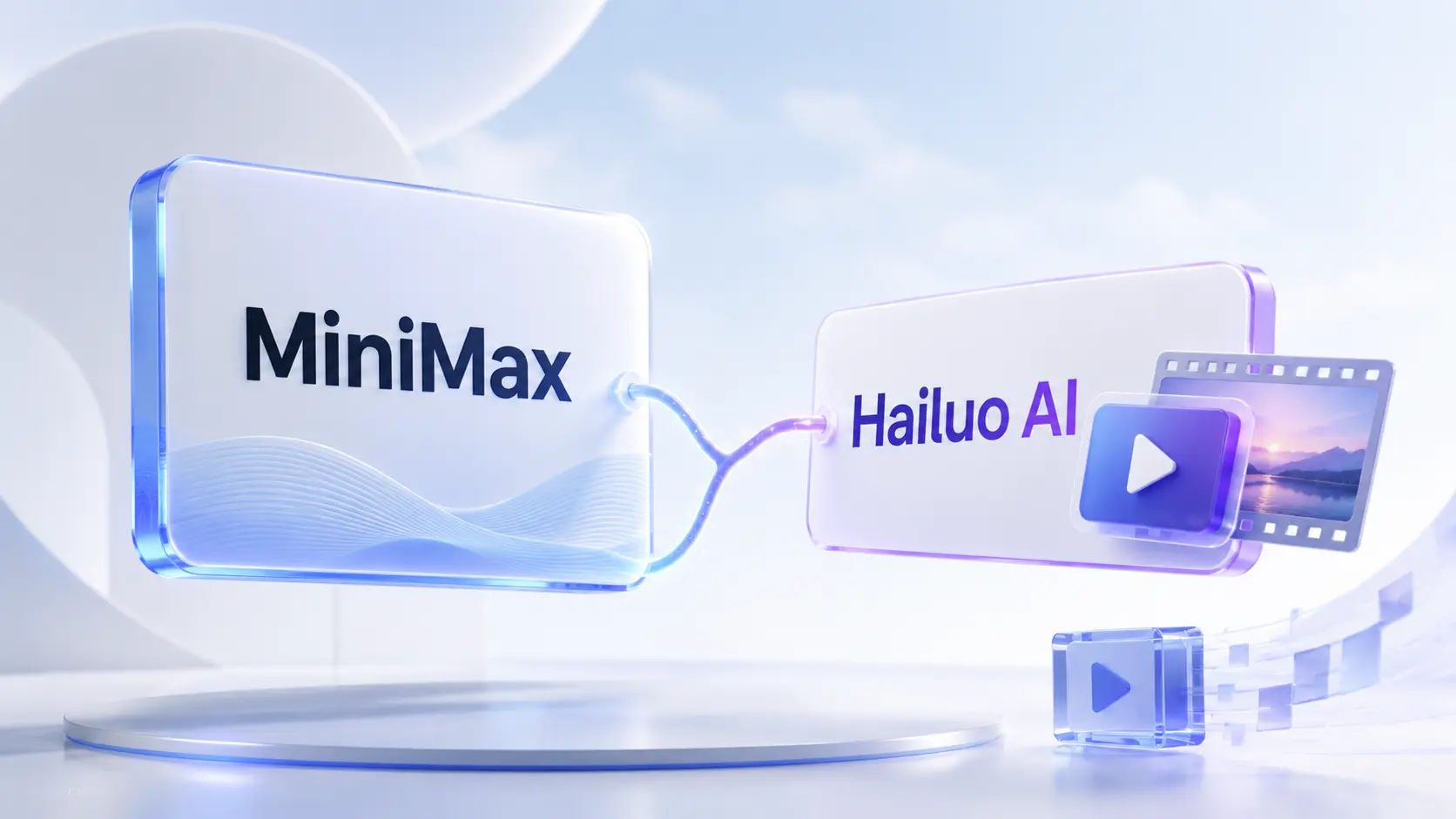
If you have been following AI video generation lately, you may have noticed two names appearing almost side by side: MiniMax and Hailuo AI. After MiniMax Hailuo appeared at Cannes as a global partner of WAIFF 2026, the question became even more common: is Hailuo AI a standalone tool, a MiniMax product, or a serious new competitor in AI video?
The short answer: Hailuo AI is part of the MiniMax ecosystem, but it has become one of the company’s most visible creative products.
That distinction matters. Many creators waste time comparing MiniMax and Hailuo as if they were separate platforms. In reality, understanding how they connect — and what Hailuo actually does well — helps you judge whether it is worth testing for AI video creation.
This guide clears up the naming confusion, explains MiniMax’s rise, and breaks down Hailuo AI’s real strengths and limits in today’s crowded AI video market.
What Is MiniMax and What Is Hailuo AI?
The naming confusion is the single biggest barrier for new users trying to evaluate this platform. Let’s untangle it.
MiniMax — The Company Behind the Technology
MiniMax is a Chinese artificial intelligence company founded in 2022, currently valued at approximately $13.7 billion. Headquartered in Shanghai, the company was established by a team with deep expertise in large-scale AI model development.
MiniMax’s mission centers on building multimodal AI — systems that can process and generate text, audio, and video. Unlike companies that specialize in one modality, MiniMax set out to build capabilities across the entire spectrum of media generation from day one.
Hailuo AI — MiniMax’s Video Generation Product
Hailuo AI is the consumer-facing video generation platform built and operated by MiniMax. Think of it like the relationship between Google (the company) and YouTube (the product) — MiniMax is the parent entity, and Hailuo AI is one of its flagship products.
When someone says “I made this with Hailuo AI,” they’re using MiniMax’s technology. When industry reports reference “MiniMax’s video capabilities,” they’re talking about Hailuo. Same technology, different labels depending on context.
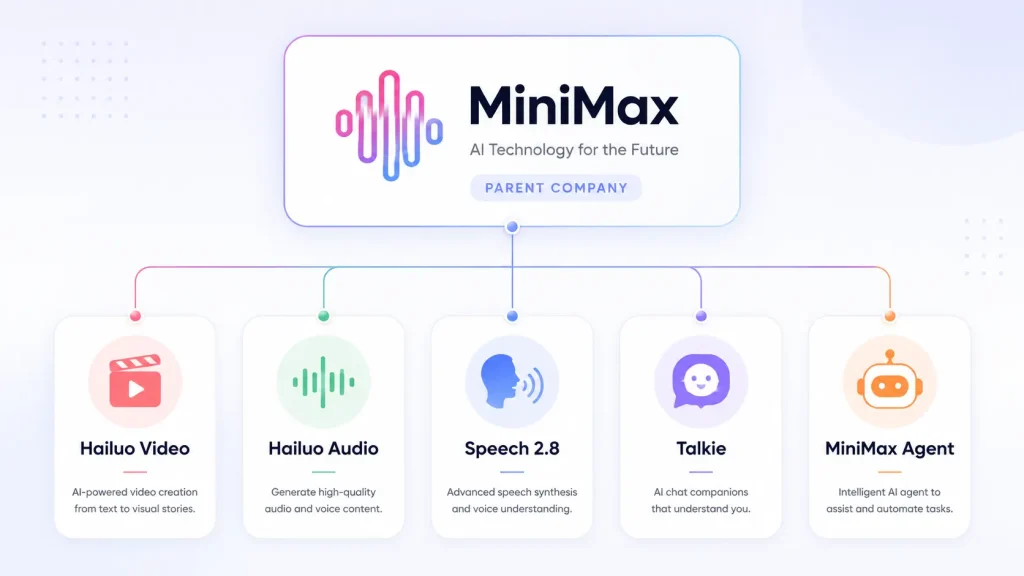
The Full MiniMax Product Ecosystem
Hailuo Video is just one piece of a broader suite:
- Hailuo Video — Text-to-video and image-to-video generation (the flagship)
- Hailuo Audio — Text-to-audio generation with multi-language support
- Speech 2.8 — Emotionally expressive voice AI, designed to produce “voices you can develop feelings for”
- Talkie — An AI character interaction platform for conversational personas
- MiniMax Agent — A general-purpose AI assistant powered by the MiniMax-M2 model (230B parameters)
- Video Agent (Beta) — Automated, zero-touch video generation
This ecosystem is what sets MiniMax apart from single-product competitors. Each tool feeds into the others, creating a multimodal pipeline that few rivals can match.
How MiniMax Achieved Rapid Growth
Going from a startup to a $13.7 billion valuation in roughly three years is extraordinary, even by AI industry standards. Here’s how it happened.
From Startup to $13.7 Billion Valuation
MiniMax attracted significant investment early, positioning itself among the top tier of Chinese AI companies alongside players like Zhipu AI and Moonshot AI. Its valuation grew rapidly through successive funding rounds, fueled by both the global AI investment boom and demonstrable product traction.
The company’s ability to ship working products — not just research papers — gave investors confidence that MiniMax could convert technology into revenue.
The Multimodal Strategy — Text, Voice, and Video Under One Roof
Most AI startups pick one lane: text generation, image creation, or voice synthesis. MiniMax bet on all of them simultaneously.
This multimodal approach paid off in two ways. First, it attracted developers who wanted a single API provider for multiple content types. Second, it created natural cross-selling opportunities — a creator using Hailuo for video might also adopt Speech 2.8 for voiceovers.
The MiniMax-M2 model, with 230 billion parameters and 10 billion active, provides the foundational intelligence that powers everything from the Talkie character platform to the Video Agent beta.
Building an Ecosystem of Products and Partnerships
Strategic partnerships accelerated adoption. MiniMax integrated Hailuo 2.3 directly into VEED, a popular professional video editing platform, on launch day. Third-party platforms like Pollo AI and FluxNote also incorporated Hailuo models, expanding its reach beyond the official website.
The Hyperbond Studio partnership produced “Call Me Sensei,” a language-learning dating simulator powered by Speech 2.8 — a creative demonstration of how MiniMax’s voice technology extends into interactive entertainment.
Global Expansion and Community Adoption
Hailuo’s growth isn’t limited to China. International creators have embraced the platform for everything from cinematic short films to anime-style music videos.
Notable examples include “NOOR,” an AI-generated love story set during the 1971 Indo-Pak War that combined Hailuo with other AI tools, and “Overlap,” an AI proof-of-concept trailer that accumulated over 664,000 views on YouTube. Reddit communities like r/singularity and r/aipromptprogramming regularly feature Hailuo comparisons and creative showcases.
What Makes Hailuo AI Stand Out in Video Generation
The AI video generation market is crowded. Veo, Kling, Wan, Runway — each platform claims superiority. Here’s where Hailuo genuinely differentiates itself.
Motion Coherence and Physics Simulation
Hailuo produces some of the most natural-looking motion in AI-generated video. Dance choreography flows realistically, crowd scenes maintain individual consistency, and object interactions follow believable physics.
This is a meaningful differentiator. Many competing platforms still produce jittery movements or physically impossible interactions that break immersion. According to side-by-side comparisons, Hailuo 2.3’s physics handling consistently outperforms its earlier versions and matches or exceeds several Western alternatives.
Emotional Micro-Expressions and Character Depth
Where Hailuo 2.3 truly shines is in subtle facial expressions — a raised eyebrow, a slight smile, a moment of hesitation. This capability makes it particularly strong for narrative and character-driven content.
A comparison of 10 emotional states across Minimax, Kling, Vidu, and Runway showed Hailuo rendering nuanced emotion with greater consistency. For creators producing storytelling content, this matters more than raw resolution.
Anime, Illustration, and Stylized Content
Hailuo 2.3 introduced dedicated optimization for anime and illustrative styles, an area where many competitors focus exclusively on photorealism. Creators working in stylized genres — anime shorts, illustrated narratives, motion comics — find that Hailuo handles non-photorealistic content with fewer artifacts.
This specialization has attracted a growing community of anime content creators who previously relied on image-only AI tools.
Versatile Generation Modes
Hailuo offers multiple input workflows:
- Text-to-video — Generate video from written prompts
- Image-to-video — Animate still images into motion
- Director Mode — Control camera angles and movements
- Subject Reference — Maintain character consistency across generations
- Video Agent (Beta) — Fully automated scene generation with minimal manual input
Each mode serves different creator needs. Director Mode is essential for filmmakers wanting cinematic control, while Subject Reference solves the persistent problem of character consistency that plagues most AI video tools.
Speed and Cost Competitiveness
Hailuo offers a free tier with daily credits, a Standard plan, and a Max plan (20,000 fast credits plus unlimited slow generations). Pricing is generally competitive with Western alternatives.
However, honesty requires noting the pain points users report. Reddit threads on r/HailuoAiOfficial describe confusing plan details, slow generation times (up to 12 hours during peak periods), and frustration with queue delays. The free tier has also seen credit reductions over time. These are real trade-offs to weigh against the quality of output.
How to Get Started with MiniMax Hailuo AI
Now that you understand the company and its capabilities, here’s how to actually start creating.
Accessing Hailuo AI Directly
The official Hailuo AI platform allows you to sign up, choose a plan, and start generating. The free tier gives you a handful of daily generations to test quality before committing.
Be aware of the credit system: plans are described in terms of credits for fast generation versus unlimited slow-queue access. Community feedback suggests reading plan details carefully before subscribing, as the distinctions between fast and slow access can be confusing.
Accessing Hailuo Through Third-Party Platforms
You don’t have to use Hailuo through its official website. Several platforms integrate Hailuo models alongside other leading AI video generators, which offers practical advantages.
For instance, AI Image to Video provides access to multiple AI video models — including Kling, Veo, and Wan — in a single interface with 4K output and no watermarks. This kind of multi-model platform lets you compare Hailuo’s output against competitors side by side, without managing separate accounts and credit systems for each.
Other integration platforms like VEED and FluxNote also offer Hailuo access bundled with professional editing tools. For creators who want to experiment with different models before settling on one, a multi-model platform is often the most efficient starting point.
Conclusion
The MiniMax/Hailuo confusion is straightforward once you know the answer: MiniMax is the company, Hailuo AI is the product. They’re one ecosystem, not two competing platforms.
MiniMax’s rapid growth to a $13.7 billion valuation wasn’t accidental — it was driven by a multimodal strategy that combined text, voice, and video under one roof, backed by smart partnerships with platforms like VEED and Hyperbond Studio.
And Hailuo’s video generation capabilities are genuinely competitive. Its strengths in motion coherence, emotional micro-expressions, and stylized content make it a serious option for creators who prioritize natural-looking, character-driven video.
Ready to try it yourself? Rather than juggling multiple platforms, consider starting with a multi-model tool like AI Image to Video where you can test Hailuo alongside other top generators in one place — with 4K quality and no watermarks. It’s the fastest way to see how Hailuo compares for your specific creative needs.