
Be honest about where your workday goes. It’s rarely the thinking part. It’s the shuffle between ChatGPT, Canva, Webflow, and your inbox, copying one tool’s output into the next. Runable AI says it can fold that whole relay race into a single chat, and it backs the claim with a 92.1% score on the GAIA agent benchmark.
The trouble is the search results. Most “reviews” are sponsored takes that gush about a demo, never quantify the credits, and skip the limits. So you’re left guessing whether Runable is a real do-it-for-you agent or just a louder chatbot.
This review answers that: what Runable AI actually is, how it works, what it builds, real pricing and credit math, head-to-head comparisons, and the honest pros and cons — including the astroturfing question circling Reddit — so you can decide before spending a credit.
What Is Runable AI? (And What It’s Not)
Runable AI is a general AI agent: software that plans and carries out complete digital tasks from one instruction, rather than just talking about them. Think of it as the difference between an assistant who describes how to build a slide deck and one who hands you the finished file.
Runable AI in one sentence (agent vs chatbot)
A chatbot replies. Runable acts. It works across connected apps and a virtual computer, and Plan Mode lets you approve each step before it runs. That execution gap is the whole point — and the lens for everything below.
Runable vs Run:ai vs LangChain “Runnable” vs runable.app
The name causes real confusion, so let’s clear it fast. Runable AI lives at runable.com (and runableai.com) and is the agent in this review. Run:ai is a GPU and MLOps orchestration platform — unrelated.
LangChain’s Runnable is a developer code interface, not a product you sign into. And runable.app is a separate privacy-focused software company that has nothing to do with the agent. If you searched “runable ai,” you almost certainly meant runable.com.
Who Runable AI is built for
Runable fits operators, marketers, agency owners, non-technical founders, freelancers, and students — anyone who deals with messy inputs and needs real deliverables out the other end. It’s a weaker pick for IDE-grade software engineering or for people who just want a chat partner. If your work is “make the thing,” you’re the target user.
How Does Runable AI Work?
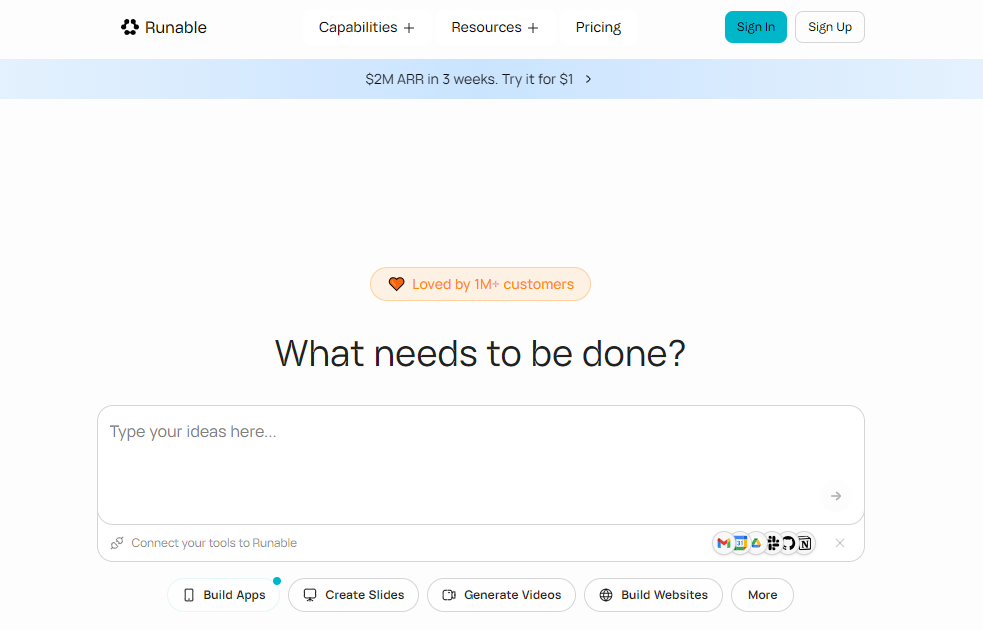
Understanding the mechanics is what separates “real execution” from marketing copy. Runable runs on a repeatable loop and a sandboxed machine that does the actual clicking and building.
The Plan → Visualize → Work → Iterate workflow
The core loop is simple: Runable clarifies your intent, previews a plan, executes, then refines. The ask-questions-first habit matters more than it sounds — pinning down what “done” looks like before generating avoids the misaligned outputs that waste time and credits.
Plan Mode and human-in-the-loop approval
Plan Mode is the trust layer. Before Runable builds anything, it shows the plan to approve, and you can fork a project or roll back a version. That preview-before-build gate is your chance to catch a wrong turn before credits are spent — a real safeguard given how fast media generation drains your balance.
The virtual computer, connectors, and brand memory
Under the hood, Runable operates a virtual Ubuntu computer, so it can browse, run files, and complete multi-step jobs like a person at a keyboard. It links to outside apps through Connectors and stores a brand Memory for consistent fonts, colors, and tone. One honest caveat: the marketed “3,000+ connectors” leans heavily on Zapier-mediated links, with roughly 50 verified native integrations underneath.
What Can You Actually Build With Runable AI?
This is where Runable earns or loses its keep. The range is genuinely broad, and each format below maps to a job people search for directly.
Slides and presentations
Slides are a standout. Reviewers have watched it spin up 26-slide decks in seconds and full investor pitch decks from a short brief. The structure and speed are impressive; the templates can feel generic, so expect light editing to match a brand.
Websites (including interactive and 3D)
Websites are the most community-praised use case. Users report landing pages, portfolios, and even 3D or interactive sites “in minutes.” It’s excellent for prototyping and idea-testing. For pixel-level polish, many still finish in Webflow or Figma.
Videos and UGC content
Runable generates video through multiple models — Veo, Sora 2, Runway, Pika, Luma, and Kling — which is great for quick ads and UGC concepts. The big caveat: video burns credits faster than anything else. Because Runable’s clips are best treated as first drafts, it pairs well with a dedicated finisher. For watermark-free 4K social and TikTok clips built from images, a specialized tool like AI Image to Video is a natural complement for the final, polished export.
Reports, deep research, and documents
For research, Runable produces deep-research reports and long-form documents, and it points to DRACO Deep Research (68.3%) and BrowserComp positioning to justify the claim. Output is solid for a first pass; verify facts before anything ships to a client.
Podcasts and AI audio
The AI Audio suite covers podcast episodes, dubbing, voice swapping, and transcription. It’s a tidy fit for repurposing written content into audio without bouncing between separate apps.
Workflow automation, connectors, and RunClaw
Beyond one-off creation, Runable automates repetitive tasks and runs on schedules. RunClaw is its agent for Slack, Discord, and Telegram, executing jobs autonomously inside the chat tools your team already uses — the answer to the recurring “does it work in Slack?” question.
Runable AI Pricing and Credits Explained (2026)
Pricing is where competitors go vague, so here’s the concrete version. Note that reported tiers vary across sources; runable.com/pricing is the source of truth.
Starter / Pro / Unlimited tiers and the $1 trial
Plans are commonly reported as Starter ~$25/mo, Pro ~$50/mo, and Unlimited ~$200/mo, with some sources citing Plus/Pro variants near $29 and $49. A viral $1 entry promo has shown up in YouTube demos as a low-risk way to test it. Everything runs on credits, not unlimited usage.
How the credit system works (and where credits burn fast)
Credits refresh on a daily and monthly basis (for example, 500 daily and 25,000 monthly on Starter). Simple text and slide jobs are cheap. Video and multi-step generation drain the balance fastest — that’s the line item to watch.
A real credit-cost worked example
No competitor quantifies this, so here’s a rough illustration of how a single busy session adds up:
- 26-slide deck: light credit use
- 30-second AI video: heavy credit use — often several times the deck
- Combined session: a deck plus one short video can eat a meaningful slice of a daily allowance, pushing heavy video users toward Pro or Unlimited
Treat these as directional and confirm current rates on the pricing page.
Is Runable AI worth the money?
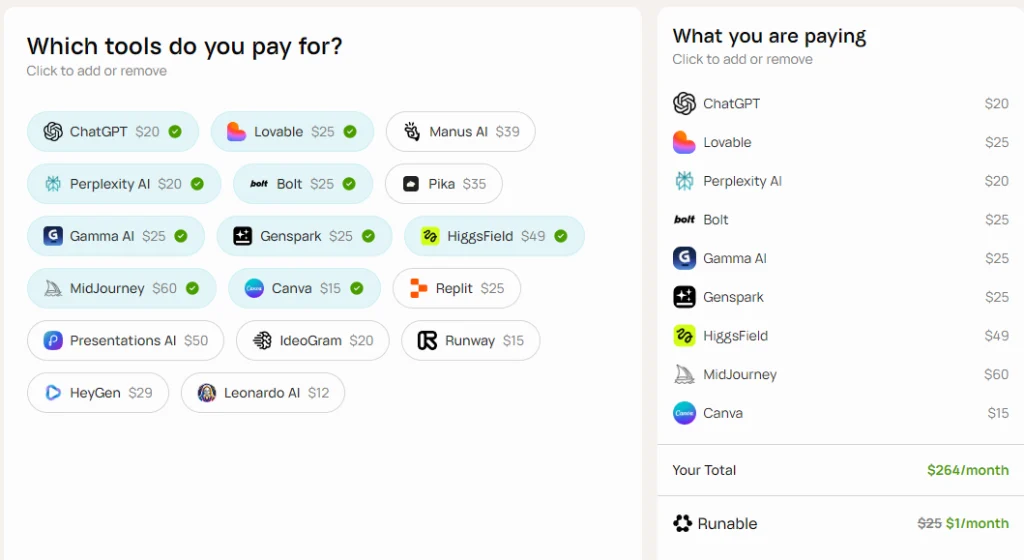
If Runable offsets two or three subscriptions — say a slide tool, a site builder, and a research helper — the math works at the Pro tier. If you mainly generate video, credits go fast and the value depends entirely on your volume. The honest answer is: it depends on your use case.
Runable AI vs the Competition
Where Runable lands depends on what you’re comparing it against. Here’s the quick map, followed by the category breakdown.
| Tool | Type | Best at | Watch-out |
| Runable | General agent | End-to-end builds across formats | Credit burn, polish drift |
| Manus | General agent | Autonomous task runs | Output consistency |
| Genspark | General agent | Research and value | Format breadth |
| ChatGPT | Chatbot | Reasoning and drafting | It replies, doesn’t execute |
| Zapier | Rule automation | Predictable workflows | No creative building |
Runable vs ChatGPT (the execution gap)
ChatGPT is brilliant at thinking and drafting, but it hands the work back to you. Runable closes that execution gap by actually producing the deck, site, or report. For “do it for me” tasks, that’s the difference that matters.
Runable vs Manus vs Genspark
Against the two leading rival agents, Runable wins on format breadth and design-led output. Manus is strong on autonomous runs; Genspark earns praise for research and value. All three are early, so test your specific workflow before committing.
Runable vs Zapier / Make / n8n
For predictable, rule-based pipelines, Zapier, Make, and n8n still win on reliability — they do the same thing every time. Runable shines on the gray-area jobs where the steps change week to week and judgment is required.
Runable vs Canva / Gamma (specialized tools)
For a quick, polished social graphic, Canva or Gamma is often faster. Runable’s edge is doing many formats in one place rather than beating any single specialist. This is the “complement, not full replacement” reality in one line.
Is Runable AI Legit? Pros, Cons, and Real User Sentiment
Yes, Runable is a real, working product — but candor is the differentiator here, so let’s include the uncomfortable parts.
What users love (the real wins)
The praise is consistent: genuine end-to-end execution, speed, strong image generation, and beating blank-page paralysis. YouTube reviewers have called it a “straight-up cheat code” and said it “replaces 5 different tools,” with one creator building an entire portfolio in roughly 20 minutes.
Real complaints: reliability, mobile, and credit burn
The recurring gripes are just as consistent. Reddit’s verdict is “powerful, just not fully reliable yet.” A broken or flaky mobile app, generic templates, fast credit depletion on video, and reported EU data-compliance gaps (no clearly listed DPA, SOC 2, or ISO 27001 per one critical audit) all come up.
The “starting tool vs finishing tool” reality
The sharpest community insight: Runable nails the first 30% — scaffolding, structure, killing the blank page — but output can drift over long iterations. Use it to start and structure, then finish in your specialist tools. Set that expectation and you’ll be happy.
Addressing the bot and astroturfing accusations
It’s worth naming directly: r/SideProject threads have accused Runable of astroturfing, with users calling posts “another transparent Runable ad” and pointing at “Runable bots.” No competitor mentions this. Read glowing posts with healthy skepticism, lean on the $1 trial, and judge the tool by your own results rather than the hype around it.
How to Get Started With Runable AI (Beginner’s First 3 Projects)
Onboarding overwhelm is real — the answer is to start with one concrete win.
Setup and your first prompt
Create an account, grab the $1 trial if it’s running, and write a single clear first prompt. The trick is specificity: state the goal, the audience, and what a finished result looks like.
The “director, not builder” mindset
The top community lesson is a mindset shift: you’re now a director, not a builder. Brief Runable like a sharp operator — give it inputs, guardrails, and an explicit “done” line. Prompt clarity is the real skill that separates good output from wasted credits.
Three starter projects with exact prompts
Try these three high-win firsts:
- Landing page: “Build a one-page site for [product], with a hero headline, three benefits, a testimonial block, and a signup CTA. Clean, modern, mobile-friendly.”
- Pitch deck: “Create a 12-slide investor deck for [startup]: problem, solution, market, product, traction, team, ask. Confident and visual.”
- Social image batch: “Generate 5 square social images promoting [offer], consistent brand colors, bold text overlay, scroll-stopping.”
FAQs of Runable AI
Is Runable AI free, and how much does it cost in 2026?
There’s a free entry point and a viral $1 trial, but real use runs on paid, credit-based tiers (reported Starter ~$25, Pro ~$50, Unlimited ~$200/mo). Check runable.com/pricing for current numbers.
How is Runable AI different from Run:ai and LangChain Runnable?
Runable AI is the general agent at runable.com. Run:ai is GPU/MLOps infrastructure, and LangChain’s Runnable is a developer code interface. Same-sounding names, completely different products.
Does Runable work in Slack, Discord, or Teams?
Yes for Slack, Discord, and Telegram via RunClaw, which runs tasks inside those chats. Coverage for other platforms is still expanding, so confirm your specific app.
Is Runable AI output production-ready or just a starting draft?
Usually a strong first draft. It handles the first 30% well; plan to finish polished work in a specialist tool.
Is Runable AI safe for EU customer data?
Approach with caution. One audit flagged missing EU compliance documentation (no listed DPA, SOC 2, or ISO 27001). For sensitive customer data, verify current terms before relying on it.
What tasks is Runable AI best (and worst) for?
Best: slides, websites, research reports, and first-draft media. Worst: high-stakes, reliability-critical automation and IDE-grade coding.
Conclusion
Runable AI is a genuine general agent that executes rather than just chats. It’s strongest at fast first drafts of slides, sites, reports, and media, and weaker on long-iteration polish, reliability, and fast-burning credits — especially on video. It can collapse much of a fragmented tool stack, but it complements rather than fully replaces your specialist finishing tools.
Try it the smart way: take Runable’s low-cost entry, run one real task with the “director, not builder” approach, and judge it on your own output. For watermark-free 4K social and TikTok video, pair it with a specialized finisher like AI Image to Video to polish what Runable starts.