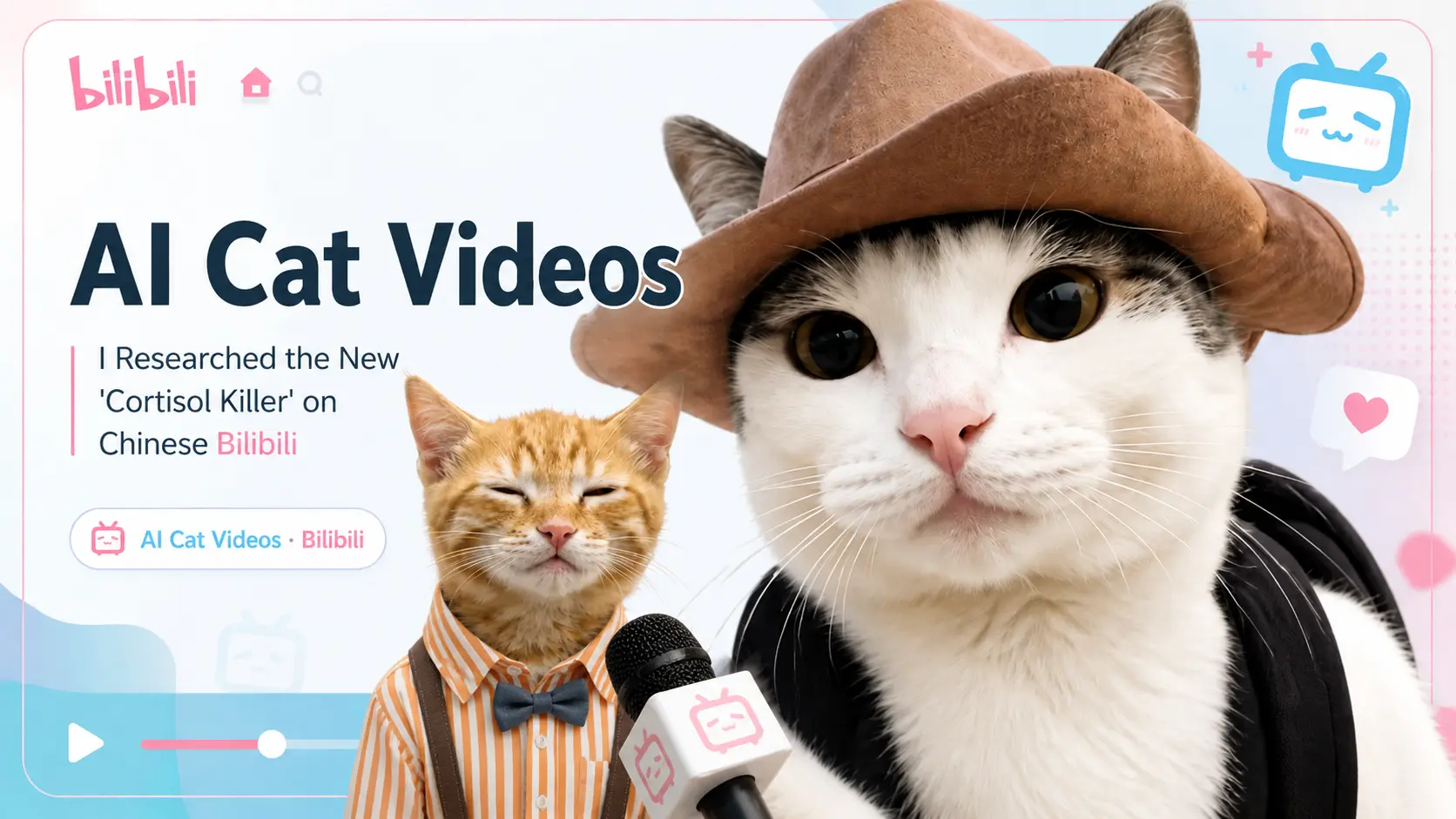
Why AI Cat Videos Are Leading AI Content Around The World
AI cat videos are becoming one of the clearest examples of how generative video moves from “technical demo” to everyday entertainment. Most people do not open Bilibili, YouTube, or TikTok to admire model quality. They open these platforms because they are bored, tired, stressed, or looking for something easy to watch between tasks. AI cat videos fit that mood almost perfectly.
This is where the phrase “cortisol killer” becomes useful, even if we should treat it more as internet language than medical fact. Cortisol is commonly described as the body’s main stress hormone, but doctors also remind people that cortisol is essential and tightly regulated, not something we should casually claim to “delete” with content. So when creators call AI cat videos a “cortisol killer,” they usually mean something softer: these videos feel like quick emotional relief.
There is some cultural logic behind that. Research on online cat video viewing has linked it with higher positive emotions and energy, and lower negative emotions after watching. That does not mean cat videos are medicine. It means they are extremely good at delivering a small emotional reset.
AI makes this format even stronger. A real cat video depends on capturing the right moment. An AI cat video can manufacture the moment: a crying cat CEO, a heroic orange cat, a meme cat surviving workplace drama, or a tiny feline protagonist trapped in a human social problem. The viewer understands the emotion in one second.
That is why AI cat videos are leading AI content globally. They combine three things that travel well across platforms: recognizable animal cuteness, meme-based character design, and simple emotional storytelling. The technology disappears behind the feeling. And that may be the real breakthrough.
On Chinese Bilibili, a video platform features young creators and users, this trend is typical visible.
This article looks at two Bilibili-style AI cat video accounts as a case study: @联普日语社区, which leans into a recurring cat character with sitcom-like daily situations, and @荒蛋记录员, which builds a broader meme-cat universe using already familiar internet cat faces. The point is not simply “AI cats are cute.” The real insight is that successful AI cat videos are not random generations. They are character systems.
For creators, marketers, and AI video product builders, this matters. AI cat videos show how a low-cost, repeatable format can become emotionally sticky, meme-friendly, and highly adaptable across Bilibili, TikTok, YouTube Shorts, Instagram Reels, and other short video platforms.
Case Study One: The IP-Style AI Cat Account
Account Shift: From Language Teaching to an AI Cat IP
The first account type, represented by @联普日语社区, is interesting because it did not start as a pure AI entertainment account. It was originally a Japanese-language teaching account, where content performance was highly unstable. Some videos received only a few hundred views, while stronger ones could reach 500k.
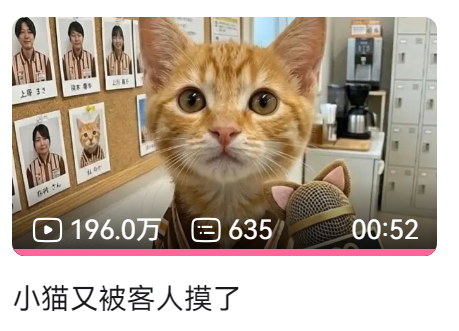
The turning point came when the creator introduced Mugi, a tiny orange cat who speaks Japanese and appears in short interview-style AI videos. After Mugi went viral, the account’s content direction became much clearer. Instead of relying on separate educational videos, the creator began focusing on Mugi. The view counts of “Mugi’s Interview Series” stabilized above 200,000, with the top videos reaching nearly 2.5 million views.
Character Design: Mugi Is a Fictional Influencer, Not Just a Cute Cat
Mugi works because the cat is not treated as a random animal generated for one video. The account gives Mugi a stable emotional identity. It is small, awkward, dramatic, confused, sometimes lazy, sometimes embarrassed, and often placed in situations that feel strangely human.
This is closer to building a fictional influencer than making isolated AI cat videos.
The audience is not only watching a cute orange cat. They are watching a tiny emotional proxy. Mugi reacts to the world in a way that feels exaggerated but familiar. When the cat is nervous, jealous, embarrassed, or socially confused, viewers can immediately understand the feeling. That is why the character does not need a complicated story world. Its personality is the story engine.
This is also why the Japanese-speaking setting works well. The language gives the character a unique surface identity, but the emotional logic remains universal. Even if viewers do not come for language learning, they can still understand the cat’s mood, conflict, and punchline.
For AI video creators, this suggests that character consistency is more valuable than visual variety. A creator does not need to generate a completely new cat every time. In fact, changing too much can weaken the audience’s memory. The stronger move is to keep the character recognizable and let the situations change.
Video Format: Small Daily Conflicts Create Repeatable Episodes
Mugi’s videos usually do not depend on huge plots. The cat is not saving the world or entering a fantasy adventure. Instead, the series often uses tiny daily-life conflicts: food, family, work, embarrassment, jealousy, misunderstanding, laziness, social pressure, or awkward conversations.
These conflicts are low-stakes, but they are easy to understand within seconds.
That is exactly why the format is repeatable. A typical Mugi-style episode follows a simple routine:
- A familiar cat appears immediately.
- A small problem is introduced quickly.
- Mugi reacts in an exaggerated or emotionally unstable way.
- The dialogue builds toward a joke, reversal, or soft emotional release.
- The viewer leaves with a clear feeling: “That was cute, funny, and weirdly relatable.”
This routine is important because short-form AI entertainment does not have much time to explain. The audience needs to understand what kind of video they are watching almost instantly. Once Mugi becomes familiar, the viewer no longer asks, “What is this?” They ask, “What happened to Mugi this time?”
That question is the beginning of series logic.
For creators using AI image-to-video or text-to-video tools, this is a practical production lesson. Do not start every video from zero. Build a recurring setup. Keep the character, tone, and structure stable, then change only the daily problem.
Growth Logic: The Account Wins Through Recognition, Not One-Time Novelty
The biggest value of the Mugi-style account is not that one AI cat video went viral. The real value is that the account found a recognizable content unit.
Before the Mugi series, the account’s performance depended more on individual topics. After Mugi became the center, the account had a clearer reason for viewers to return. This is the difference between topic-based traffic and character-based traffic.
Topic-based traffic asks: “Is this video useful or interesting today?”
Character-based traffic asks: “What is this character doing today?”
That second question is much stronger for long-term series building. It allows the creator to reuse the same emotional asset across many situations. The cat can appear in interviews, daily conversations, mini-dramas, social misunderstandings, workplace jokes, family scenes, or language-learning moments. The world can expand, but the center stays fixed.
This gives AI video creators a more reliable routine:
- Start with one memorable character.
- Give it a clear emotional flaw or personality pattern.
- Place it in simple human situations.
- Keep the format easy to recognize.
- Use each new episode to deepen audience familiarity.
For an AI video generation platform, this case study is especially useful because it proves one thing: the future of viral AI video is not only about better visuals. It is about repeatable characters, emotional formats, and low-cost storytelling systems that creators can produce again and again.
3. Case Study Two: The Meme-Cat Universe Account
Account Model: From Meme Clips to an AI Cat Channel
@荒蛋记录员 represents a very different account model from the Mugi-style character account. Instead of building around one original cat persona, it pulls from a wider pool of already-famous internet cat meme faces and turns them into repeatable AI video content. In other words, this is not a one-cat IP strategy. It is a meme-cat universe strategy. Bilibili search results show the most viral one among its 28 videos reaches more than 12 million views, even another 3 videos approaching the 10 million-view level as of the time of publication of this article.
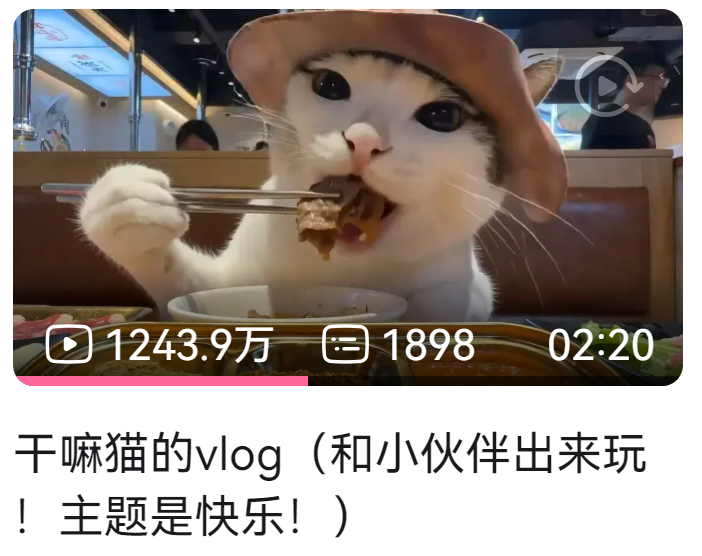
That gives the account a different growth advantage. A single-character account builds loyalty through familiarity with one recurring personality. A meme-cat account builds attention through instant recognition. The viewer sees a familiar meme face and immediately thinks, I know this cat. That lowers the barrier to watching and makes the hook work faster.
Character Strategy: Give Meme Cats a Second Life
The creative core of this account is not simply “use a funny cat.” Its real strength is taking a meme “Canny Cat” that already exists in audience memory and expanding that cat into a role.
A static meme usually has a short life. It works as a reaction image, a sticker, or a joke template. But AI video changes the format completely. Once the meme cat gets movement, voice-like rhythm, props, outfits, and a setting, it stops being a static image and starts acting like a performer.
That is what this account does well. A familiar cat face is no longer trapped in one old joke. It can become a food blogger, a workplace struggler, a holiday vlogger, a friend on an outing, or a low-energy office cat trying to survive the day. In Douyin/Bilibili search snippets tied to the account, you can already see this role-expansion clearly: overwork anxiety, holiday vlog, outing with friends, and other daily-life setups appear again and again.
I also noticed that some of the video backgrounds appear to be real footage—or at least keyframes composited from real photographs—rather than being generated directly from prompts. This clearly enhances the sense of authenticity in the “vlog” format.
For AI video creators, this is a very important lesson: you do not always need to invent a new character from zero. Sometimes the better move is to take a character the internet already remembers and build a richer personality around it.
Episode Formula: Recognizable Cat, New Role, Daily Plot
This account also has a very clear repeatable routine, which makes it highly scalable. Its videos often feel less like pet clips and more like tiny animated sketches.
A common formula looks like this:
- Start with a recognizable meme cat face.
- Assign the cat a new role or identity.
- Place it in a simple daily scenario such as work, food, holidays, social life, or emotional struggle.
- Use AI motion and editing to turn that setup into a short mini-episode.
- End with a light joke, emotional release, or relatable mood.
This is why the account feels fresh without needing a giant narrative world. The audience already recognizes the face, so the video does not need much explanation. The novelty comes from the reframing: what new life is this meme cat living today?
Compared with the Mugi-style format, which depends on one stable personality, this format depends more on modular recombination. The account can rotate different meme cats, different settings, and different moods while keeping the same basic creative logic. That makes it especially useful for creators who want volume and variety without losing audience recognition.
Growth Logic: Recognition First, Monetization Second
The business value of this model is also strong. Because the cat is the main attraction, the surrounding scenario can change very flexibly. A meme cat can become a food vlogger, a lifestyle creator, a tired office worker, or a chaotic daily-life narrator. That means the content can naturally open up different storytelling lanes — snacks, routines, work jokes, lifestyle moments, and even soft brand integration.
This is the strategic difference: the ad or scenario is not the event — the cat is the event.
That makes the account commercially interesting. If the audience clicks because they already recognize and enjoy the cat, then product placement or branded context can be inserted more naturally inside the story world. The entertainment layer protects the content from feeling too much like an ad, as long as the scenario remains funny or emotionally relatable.
For AI video creators, the takeaway is clear. If the Mugi-style account teaches the value of one strong recurring character, @荒蛋记录员 teaches the value of a reusable meme-character system. One model builds depth through consistency. The other builds scale through recognition. Both work — but this second model is especially powerful for creators who want to turn internet meme memory into a repeatable AI video pipeline.
A Practical Blueprint for Your Own AI Cat Video Series
Here is a simple blueprint for creators who want to build an AI cat video series for Bilibili, TikTok, or YouTube Shorts.
Start with one cat archetype. Do not begin with ten characters. Choose one strong emotional identity: anxious, greedy, arrogant, dramatic, lazy, confused, or overly polite.
Create a visual anchor. This could be a face shape, outfit, color, expression, or recurring prop. The viewer should recognize the cat even before reading the caption.
Choose AT LEAST ONE repeatable setting. For example: kitchen, office, convenience store. Or classroom, bedroom, street stall. Too many settings can make the account feel inconsistent. If you can make your AI cats keep the same visual characters in all “travel vlogs”, trying different background is a good choice, too.
Write tiny conflicts. Short-form AI cat videos work best when the conflict is immediately clear: the cake is missing, the boss is coming, the snack is too expensive, the cat lied, the cat failed an exam, the cat got caught.
Keep the ending simple. Use a reversal, overreaction, freeze-frame, awkward silence, or caption punchline.
Track what viewers repeat in comments. If viewers give the cat a nickname, repeat it. If they quote one line, make it part of the character. If they mock one behavior, turn it into a recurring flaw.
Then scale.
The goal is not to make one perfect AI cat video. The goal is to discover a repeatable emotional machine.
Conclusion: The Future of AI Cat Videos Is Character IP
AI cat videos may look silly at first glance. But the Bilibili accounts we analyzed show a deeper shift in online video creation.
AI is turning static memes into moving characters. It is turning one-off jokes into repeatable series. It is turning familiar internet cat faces into food bloggers, vloggers, office workers, students, and tiny emotional mascots for modern stress.
That is why the “cortisol killer” label feels accurate as internet slang. People are not only watching cats because they are cute. They are watching because these AI cats absorb daily frustration and return it as comedy.
For AI video creators, the lesson is clear: do not just generate cats. Build characters.
For AI video tools, the opportunity is equally clear: make it easier for creators to keep character consistency, animate still images, test short scenes, and produce repeatable formats.
The next wave of AI video may not begin with cinematic trailers or perfect digital humans. It may begin with a stressed little cat staring into the camera, holding a piece of cake, and somehow saying exactly what the audience feels.