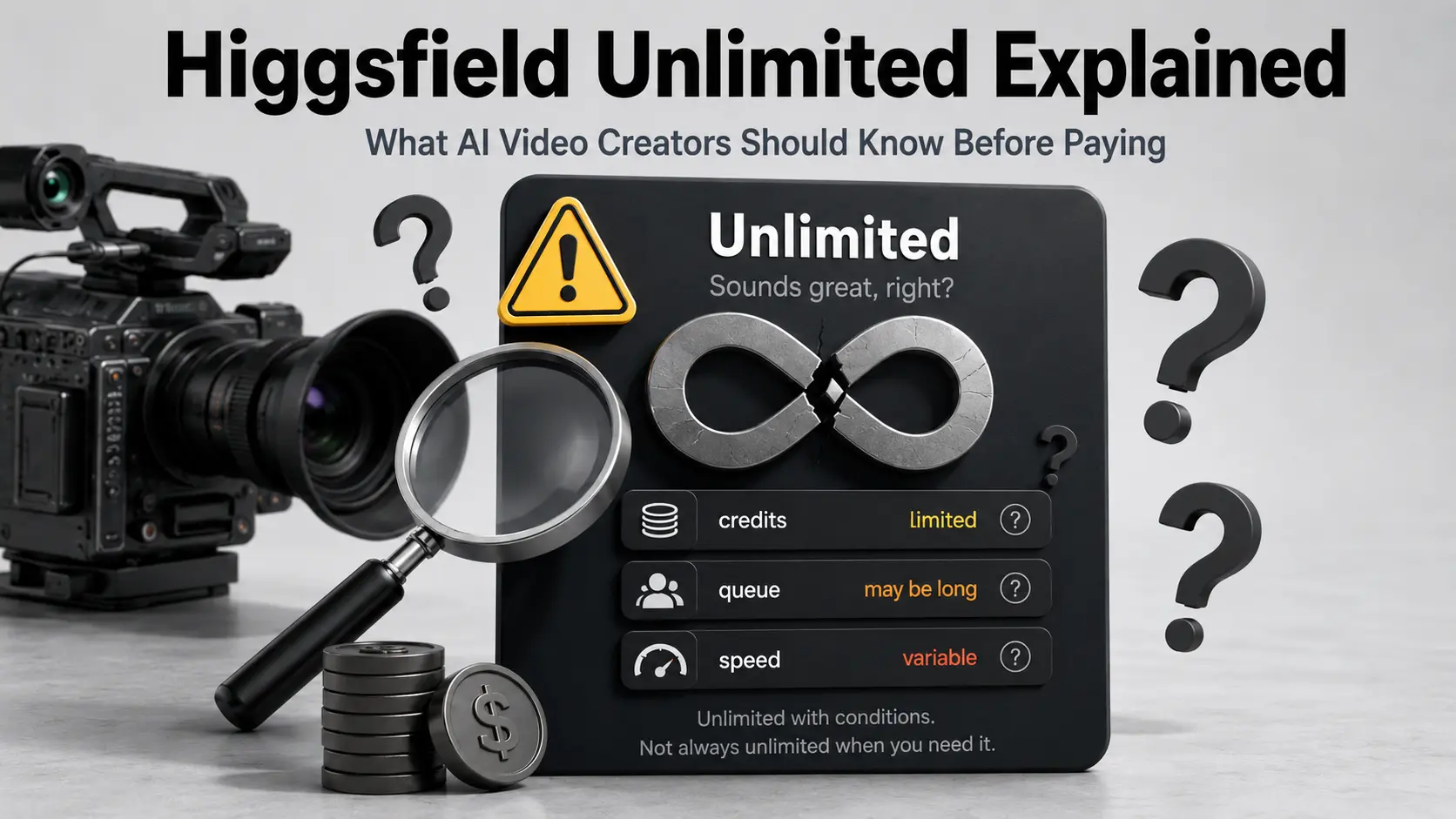
You subscribed to Higgsfield’s Unlimited plan expecting endless AI video generation. Then you hit a throttled queue, a resolution cap, or a “reached your limit” error on day three. You are not alone — and the confusion is not your fault.
After analyzing pricing data from dozens of sources, Reddit threads, and YouTube reviews, users‘ complaint on Higgsfield’s “unlimited” comes with several distinct restrictions not clearly disclosed at purchase. Are they true? Or Higgsfield is over expected? Let’s read the model badges, duration notes, and fair-use details carefully to decode every restriction and compares Higgsfield’s “unlimited” marketing with AI Image to Video’s .
What Is Higgsfield AI?
How Higgsfield Works as a Multi-Model Aggregator
Higgsfield is a multi-model aggregator — a single interface wrapping third-party AI models like Kling 3.0, Sora 2, Google Veo 3.1, Seedance 2.0, and WAN 2.6. It adds proprietary tools on top: Cinema Studio for camera controls, Soul ID for character consistency, and LipSync Studio.
This wrapper model is key to understanding pricing. Yaroflasher’s YouTube investigation confirmed Higgsfield wraps Kling AI and Minimax at a 2-4.5x markup over native platform pricing.
Key Models Available on Higgsfield
The platform spans three categories:
- Video: Kling 3.0, Sora 2, Veo 3.1, Seedance 2.0, WAN 2.5/2.6, MiniMax Hailuo
- Image: Nano Banana Pro, GPT Image 2, Seedream 5.0, FLUX.2 Pro/Max
- Editing: Cinema Studio 3.5, LipSync Studio, 4K Upscale, Inpaint
Not all models are available on all plans, and “Unlimited” access applies to a specific subset — not the full model library.
What Does “Unlimited” Actually Mean on Higgsfield?
365-Day Unlimited Model Passes
Ultra-tier annual subscribers ($99/month billed annually) receive a 365-day unlimited pass for one select image model — choose from Nano Banana 2, Wan 2.6, Seedance 1.5 Pro, or Kling 2.6. Volume is genuinely unlimited, but generations route through a slower “standard mode” queue and are subject to the battery system that progressively degrades speed.
7-Day Unlimited Model Promotions
Higgsfield periodically offers “unlimited” access to premium video models (Kling 3.0, Seedance 2.0) for paying subscribers. The fine print matters:
- Access lasts 7 calendar days, not 168 hours — one Reddit user reported access ending after ~5.5 days
- Resolution locked at 720p
- Concurrent generation capped at 2-4 simultaneous jobs
- Queue times balloon as all unlimited users compete for shared capacity
This is a temporary promotion, not a permanent plan feature.
Fair Use, Dynamic Speed Limits, and the Unlimited Queue
The battery system is Higgsfield’s speed-throttling mechanism: the more you use unlimited mode, the slower your generations become. Users report speeds ranging from 2 minutes to over 2 hours for the same model. It functions as a soft rate limit disguised as a technical system — while credit-based generation of the same model finishes in under 1 minute.
Concurrency Limits and Fair Use Caps
Unlimited mode allows only 2-4 simultaneous generations, reduced from 8 after the Christmas 2025 changes. The “reached my limit” error on Ultimate plans is a concurrent cap — not a total volume cap — but the UI does not explain this clearly.
Resolution Restrictions in Unlimited Mode
All unlimited video output is capped at 720p. Users needing 1080p or 4K must spend credits on upscaling (12-20+ credits). A common workaround: generate at 720p unlimited, then upscale externally with Topaz Video AI. The duration is also limited to 5 second.
Unlimited Access vs Credit-Based Priority: The Speed and Quality Gap
How the Two-Tier Queue System Works
Higgsfield runs two parallel queues. Credit-based generations finish in under 1 minute. Unlimited-mode generations average 10-25 minutes for video — degrading further under the battery system. Same models, same platform, different priority.
Key Takeaway: “Unlimited” is not a premium tier on Higgsfield. It is the economy lane.
Why Credits Deplete Faster Than Users Expect
Credit consumption per generation adds up fast:
- Kling 3.0: ~7-8 credits per 5-second video
- Seedance 2.0 (720p): ~25 credits per 5-second clip
- Veo 3.1 with audio: ~58 credits per 8-second clip
- Cinema Studio sessions: 50-80+ credits
- LipSync: 12-20 credits
At Ultra tier (3,000 credits/month), that yields roughly 37-42 Kling 3.0 clips — before factoring in a reported 25-50% failure rate on some models that still consumes credits.
The Hidden Cost of Iteration
Creative workflows require 3-5 variations per concept, and failed generations still consume credits. One fashion brand owner burned 90% of monthly credits in under a month. Another user calculated a 5-minute video at ~$200 AUD.
How to Read Higgsfield Pricing Without Getting Confused
| Pricing item | What to check before paying |
| Monthly price | Is it billed monthly or annually? |
| Credits | How many credits are included each month? |
| Unlimited badge | Which exact model is Unlimited? |
| Duration | 365-day or N-day access? |
| Resolution | Which resolutions are included? |
| Queue | Unlimited queue or priority queue? |
| Concurrency | How many generations can run at once? |
| Subscription condition | Does Unlimited end if the subscription ends? |
Annual vs Monthly Billing — The Fine Print
Annual billing is displayed as a monthly rate but charged as a full upfront payment. Ultra shows “$99/month” but charges $1,188 at checkout. Given Higgsfield’s history of changing terms mid-subscription, community members widely recommend monthly billing despite the higher per-month cost.
How Pricing Has Changed
Higgsfield has restructured pricing at least three times — original tiers (Basic $9/Pro $17-29/Ultimate $24-49/Creator $49-249) transitioned to the current Starter/Plus/Ultra/Business structure. Early Creator plan subscribers paid $149.40/month; the same plan was later offered at $37.40/month. “Unlimited” terms have also changed retroactively for existing subscribers.
Where the “Scam” Accusations Come From — And What Is Actually Happening
The Christmas 2025 Account Purge
On December 19, 2025, Higgsfield mass-banned heavy unlimited plan users. Yaroflasher’s investigation documented leaked Discord messages confirming internal awareness, triggering Trustpilot review-bombing and BBB complaints.
Retroactive Changes to Existing Subscriptions
Users who purchased plans with specific features found them changed post-purchase: concurrent slots slashed from 8 to 2, censorship filters applied retroactively, and the battery system replaced original unlimited speeds — all without notice.
UX Patterns That Erode Trust
A CGI professional’s 2-month review on Reddit after 9,000+ generations documented dark patterns: the mobile app resets the “Unlimited” toggle on every generation, defaulting to credit-based mode and making accidental credit spending nearly inevitable. Some issues, like the “Danger Zone” cancellation button, have since been improved.
Why These Issues Generate “Scam” Language
When users discover time limits, throttling, resolution caps, and battery degradation — none clearly communicated at purchase — the emotional response is predictable. The core issue is not fraud but a significant transparency deficit that fuels overpromise and disappointment.
Higgsfield Unlimited vs AI Image to Video Unlimited
Higgsfield and AI Image to Video both use the word “Unlimited,” but they mean different things. Higgsfield’s Unlimited is best understood as access to selected models for a defined period. For supported models, generations may not deduct overall credits, but access still depends on the plan, model badge, resolution, subscription status, queue availability, concurrency limits, and fair-use rules.
AI Image to Video takes a simpler approach for creators who mainly want to turn images into short-form videos. New users can get free daily access to its proprietary Video Fast 1.0 foundation model, with no credits required and no registration needed. For creators testing image-to-video ideas, product visuals, TikTok clips, or social media content, this lowers the barrier to experimentation without forcing them to calculate credits before every generation.
The biggest difference is how each platform frames access. Higgsfield is built around a multi-model system, with tools such as Cinema Studio, Soul ID, LipSync Studio, and access to advanced models like Kling, Veo, Sora, Seedance, and Wan depending on the plan. That flexibility can be powerful, but it also makes the pricing harder to read. Users need to check which models are included, how long Unlimited access lasts, whether the generation runs through the Unlimited queue or priority queue, and what resolution is supported.
AI Image to Video is more focused on the image-to-video workflow itself. Instead of positioning Unlimited as access to a broad and changing model library, its foundation model is designed for creators who want a more direct path: upload an image, generate a video, and test short-form ideas without dealing with complex credit math. The platform also supports advanced models such as Kling, Veo, and Wan for users who need different output styles or higher-quality generations, with output up to 1080p and no watermarks depending on the selected workflow.
In short, Higgsfield is better for users who want access to a broader creative AI studio and are willing to manage model-specific rules, queues, credits, and plan details. AI Image to Video is better suited for creators who want a more direct image-to-video workflow, especially for TikTok, Shorts, Reels, product demos, and social media content where fast testing and simple access matter more than navigating a complex pricing system.
FAQs About Higgsfield Unlimited
Is Higgsfield Unlimited actually unlimited?
Volume is technically unlimited for covered models. However, speed is throttled via the battery system, resolution is capped at 720p, concurrent generations are limited to 2-4, and video model “unlimited” is often a 7-day promotional window — not a permanent feature. Image model passes last 365 days on annual Ultra plans.
How fast is Higgsfield Unlimited mode compared to credits?
Credit-based generation typically completes in under 1 minute. Unlimited mode ranges from 2 minutes to over 2 hours depending on model, platform load, and battery status. Speed degrades the more you generate within a session.
Can I cancel my Higgsfield annual plan and get a refund?
Higgsfield offers a 7-day refund window with two conditions: zero credits used and up to 6% cancellation fee. After 7 days, annual plans are non-refundable even if features change. Some users have obtained refunds through bank chargebacks.
What is the Higgsfield battery system?
A speed-throttling mechanism that progressively slows unlimited-mode generations the more you use them. It was introduced after earlier “unlimited” controversies and effectively creates a soft rate limit on what is marketed as unlimited access.
Is AI Image to Video a good alternative to Higgsfield for social media videos?
For creators focused on converting images into short-form social videos, AI Image to Video offers 4K output, no watermarks, batch processing, and transparent pricing — without the credit complexity and throttling that affect Higgsfield’s unlimited users.
Does Higgsfield charge the full annual price upfront?
Yes. Annual plans display monthly rates on the pricing page but charge the full annual amount at checkout. Ultra at “$99/month” results in a $1,188 upfront charge.
Conclusion
Higgsfield’s “Unlimited” is not a lie — but it’s also not the kind of unlimited high-speed video generation users might intuitively expect. It functions more like time-limited access to specific models without deducting from your overall credits, while still being subject to restrictions on speed, concurrency, resolution, model availability, and subscription status. The worst part is that the reality of these restrictions far exceeds the users’ tolerance.
Although AI Image to Video also uses the word “Unlimited”, it is totally another concept defferent with Higgsfield. Try AI Image to Video and experience what straightforward AI video generation looks like — no credit math required.