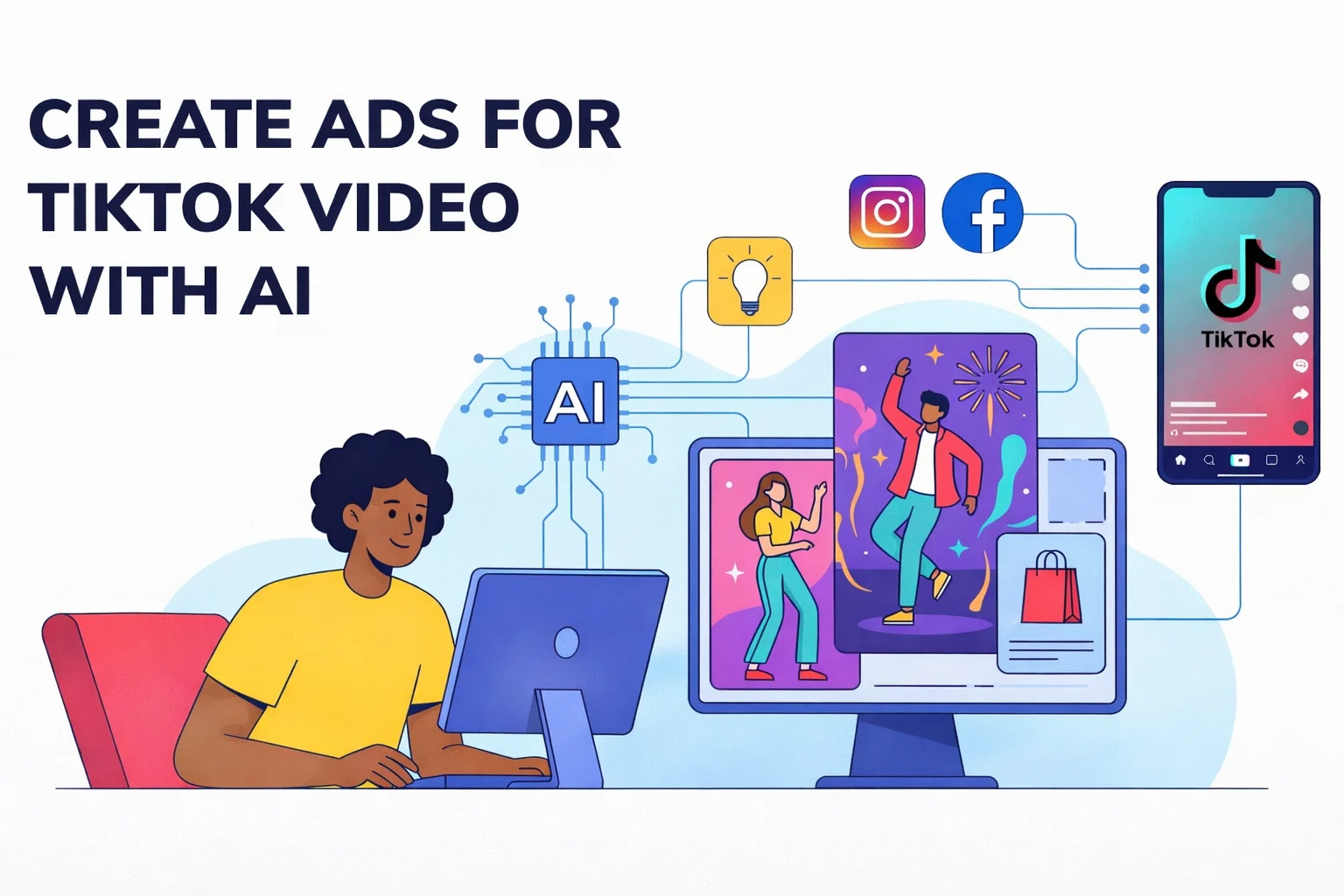
What if you could create ads for TikTok video with AI at the pace TikTok actually rewards—fast, iterative, and ruthless about what works?
Traditional TikTok ad production is a bottleneck. A single UGC video can run $300–$500, and that price tag quietly kills the one thing TikTok campaigns need most: variation. When you can’t afford to test, you end up “betting” on one creative idea… and the algorithm doesn’t care about your bet.
AI changes the economics. Not because every AI ad is amazing, but because an AI TikTok ad generator lets you produce enough versions to discover the hook, angle, and format your audience will actually watch. Think of AI as your creative lab: rapid drafts, rapid edits, rapid learnings.
This pillar guide gives you a practical framework—from beginner to pro—for building TikTok video ads with AI: picking the right AI TikTok ad creator, writing TikTok ad scripts that win the first seconds, making AI UGC look native, running batch testing on ad variations, and handling TikTok AI disclosure and compliance in a way that keeps you safe.
What Are AI TikTok Ads
AI TikTok ads are video ads produced with AI tools instead of filming everything from scratch. In real workflows, “AI ads” usually means one (or a mix) of these approaches:
- Text-to-video (AI video ad generator): you describe a scene; the model generates visuals.
- Image-to-video: you upload product photos; the AI animates them into motion clips.
- AI avatars / AI spokesperson videos: a digital presenter delivers your script on “camera.”
- AI editing assistants: auto captions, cut detection, templates, quick pacing fixes.
People often imagine a fully automatic machine: type a sentence, get a perfect TikTok ad. That’s not the real advantage. The real advantage is speed + repeatability. AI helps you generate “draft-level” creatives quickly, then you shape them into TikTok-native ads with pacing, captions, and hooks that feel like real content—not like a commercial.
If you’ve ever searched phrases like create TikTok ads with AI, AI TikTok ad maker, or make TikTok video ads with AI, the intent is the same: get ads made faster, cheaper, and with enough versions to test.
AI Ads vs Traditional UGC: Honest Comparison
Here’s the reality check before you build your workflow:
| Factor | AI TikTok Ads | Traditional UGC |
| Cost | $0–$100+/month tools | $300–$500 per video (often more) |
| Speed | minutes to hours | days to weeks |
| Scalability | high (variants are cheap) | limited by budget + creator capacity |
| Authenticity | improving; can be detectable | naturally human |
| Best use | rapid testing, iteration | trust, emotion, brand building |
AI is unbeatable for creative testing. Traditional UGC still wins when the product needs a human face to create trust (skincare testimonials, premium positioning, “this changed my life” stories). The smart approach is hybrid: use AI for volume, then decide whether to keep scaling with AI or remake winners with real creators.
Who Should Use AI TikTok Ads
AI TikTok video ads are a strong fit if you’re:
- A dropshipper testing multiple products and angles.
- A TikTok Shop seller producing lots of product clips quickly.
- A small brand that needs TikTok ad creatives but can’t afford constant UGC.
- A faceless content creator building ads without showing your face.
- An agency that needs consistent output across multiple client brands.
AI is less ideal if your conversion relies on deep emotional proof: founder stories, highly personal testimonials, luxury positioning where “synthetic” perception hurts. In those cases, AI can still help behind the scenes (scripts, storyboards, rough cuts), while the on-camera content remains real.
Choosing the Right AI TikTok Ad Creator
Most tool overwhelm comes from skipping the decision framework. Use this instead:
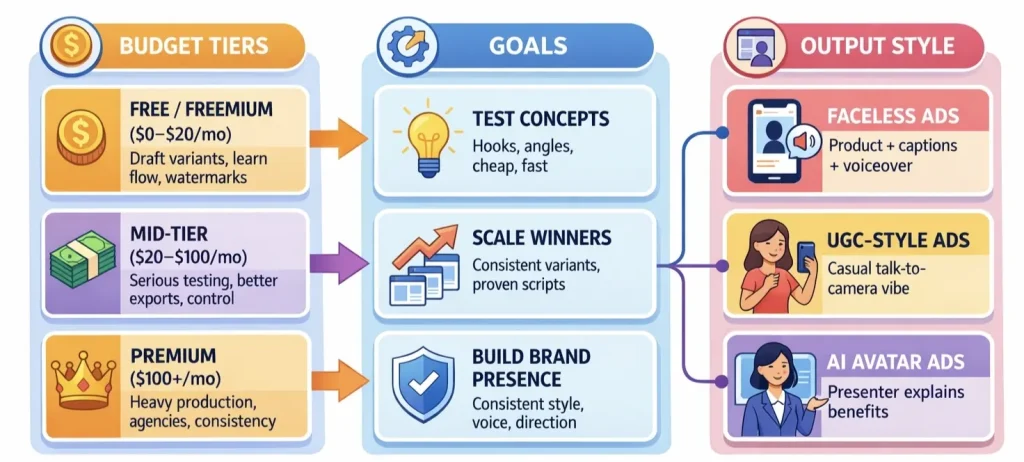
Budget tiers: free vs paid AI TikTok ad generator tools
- Free/Freemium ($0–$20/mo): learn the workflow, draft variants, tolerate watermarks.
- Mid-tier ($20–$100/mo): serious testing, better exports, more control.
- Premium ($100+/mo): heavy batch production, agencies, higher consistency.
Goals: what you’re actually trying to do
- Test concepts: hooks and angles, cheap and fast.
- Scale winners: consistent variants around proven scripts.
- Build brand presence: consistent style, voice, and creative direction.
Output style: what format fits your product and audience
- Faceless ads: product visuals + captions + voiceover (often easiest to make “native”).
- UGC-style ads: casual talk-to-camera vibe (real or AI-assisted).
- AI avatar TikTok ads: a presenter explains benefits on camera.
If you’re new, start with faceless. If you’re already advertising, add avatars only when you can keep them from looking uncanny.
TikTok Ad Script + Hook Templates
On TikTok, the creative is the targeting. The hook decides whether your ad gets watched long enough to deliver the message.
The TikTok 3-second rule (in plain language)
People decide to scroll in seconds. That’s why your 3-second hook matters more than your transitions, filters, or fancy visuals. If the first moments feel slow, generic, or overly “ad-like,” your view rate collapses—and performance follows.
The 4-part TikTok ad script framework
Use this structure when you’re writing AI-generated ads or UGC-style scripts:
- Hook (0–3s): stop the scroll
- Problem (3–8s): name the pain in their language
- Solution (8–20s): show the product doing the job
- CTA (last 3–5s): one clear next step
Don’t cram five benefits into one ad. One ad, one idea. If you have multiple benefits, that’s multiple variations.
7 hook formulas you can batch test
These are reliable because they’re easy to vary without changing the whole script:
- Problem mirror: “If you’ve ever struggled with ___…”
- Contrarian: “Stop doing ___ like this…”
- Before/after: “I tried it the normal way… then this…”
- Micro-demo first: show result → explain later
- Curiosity gap: “I didn’t expect this to work…”
- Cost/time punch: “I used to spend ___ on ___…”
- Objection flip: “I thought this was fake until…”
When you’re learning, don’t invent new styles every day. Rotate these and let data tell you what your niche responds to.
ChatGPT Prompts for TikTok Ad Scripts
ChatGPT can generate dozens of drafts fast. The mistake is asking for “a script” and accepting the first output. Instead, ask for controlled variation.
Here’s a prompt pattern that works well for chatgpt tiktok ad script prompts:
- Ask for 10 scripts
- Force different hook types
- Force one benefit only
- Force spoken, casual tone
- Ban corporate words
- Require a demo moment
- Keep it short
Then do a second pass:
- “Rewrite #3, #7, #9 with more human rhythm: short sentences, one pause, one small real-life detail.”
This is where “AI script” becomes “TikTok script.”
If you’re creating UGC-style ads, add one more rule: “Make it sound like a friend giving a tip, not a brand selling.”
How to Make AI TikTok Ads Look Real
The most common complaint is simple: “AI ads look awkward.” Usually, it’s not one issue. It’s a pile of tiny signals that make the viewer feel something is off.
If you’re building AI UGC TikTok ads, your job is to stack “native signals” and remove “synthetic signals.”
The 7-point AI UGC authenticity checklist
- Voice matches the visual (casual voice for casual content)
- Lip-sync is believable (or avoid showing lips; go faceless)
- Movement isn’t too smooth (TikTok content has texture)
- Background feels real (not sterile stock-room energy)
- Pacing matches TikTok (fast cuts, no dead air)
- Captions look native (simple, readable, timed)
- Intentional imperfection (small pauses, imperfect phrasing)
A quick reality: faceless ads often win because they dodge lip-sync and micro-expression problems. If your avatar looks even slightly off, switch formats and keep the same script.
Stylized vs hyper-realistic AI avatars: which performs better?
A lot of advertisers report that stylized avatars can outperform hyper-real ones, because they don’t trigger “is this real?” suspicion. Viewers accept the format and focus on the message.
Hyper-real attempts can backfire when the face is 95% right. That last 5% makes people uncomfortable.
Quick fixes for fake-looking AI videos
If you only have 10 minutes, do these:
- cut 15–25% of pauses
- add jump cuts at sentence turns
- replace default music
- tighten captions to keywords
- add a micro-demo clip
- delete slow intros like “Hi everyone…”
- shorten CTA to one action
Most “robotic” ads aren’t fixed by changing tools. They’re fixed by pacing and delivery.
Batch Create and Test TikTok Ad Variations
AI isn’t about making one perfect ad. It’s about making enough variations that the platform tells you what works.
If you care about performance, you must care about creative testing.
The variation testing framework
Test across:
- Hook variations (scroll-stoppers)
- Angle variations (which benefit/pain)
- Visual style (faceless vs avatar, background, pacing)
- CTA variations (what action you push)
This is what people mean by batch testing TikTok ads: you’re changing one variable at a time, at scale.
Minimum viable testing numbers (without burning your budget)
Start with a simple matrix:
- 5 hooks
- 2 angles
- 2 visual styles
That’s 20 ads. With AI, 20 isn’t crazy. It’s normal.
If you can only do 10, keep hooks as the priority. Hooks decide distribution.
What to measure first (before ROAS)
Watch these early indicators:
- 3-second view rate (hook health)
- average watch time (pacing + clarity)
- hold rate at 5–8 seconds (problem framing)
- CTR (offer + CTA)
Kill losers fast. Iterate winners. AI helps you stay disciplined because making the next version is cheap.
From testing to scaling: when to add real UGC
A simple rule:
- If an AI concept wins, you validated the angle.
- Then decide whether to scale with more AI variations or remake the winner with real UGC for stronger trust.
Many teams do both: AI keeps the pipeline full; real creators become “hero creatives” for proven offers.
TikTok AI Disclosure and Compliance Basics
Policies evolve, and enforcement can vary. Still, some principles stay consistent: don’t mislead viewers, and don’t fake endorsements.
The safe approach to TikTok AI disclosure
If your ad includes synthetic elements that could confuse people—especially a human-like presenter—treat disclosure as the safer default. It’s not about scaring yourself; it’s about avoiding avoidable risk.
FTC disclosure basics for AI ads
The big risk zone isn’t “AI visuals.” It’s endorsements and testimonials. Don’t imply a real customer said something if they didn’t. Don’t present an AI avatar as a real person sharing real lived experience.
Common compliance mistakes to avoid
- Presenting an AI avatar as a real customer testimonial
- Making results claims without context (especially health/finance)
- Using a real person’s voice likeness without permission
- Hiding disclosures in tiny text or fast frames
If your niche is sensitive, be extra conservative and document your choices.
Your First AI TikTok Ad: Quick-Start Roadmap
Step 1: pick one workflow
Choose one:
- URL-to-video (fastest drafts)
- image-to-video (best when you have product photos)
- faceless script + captions + voiceover (most controllable)
Step 2: write 5 hooks + 2 angles
Keep it strict: one benefit per version. Use the hook formulas above.
Step 3: generate the videos, then edit for pacing
Trim, jump cut, caption, and keep it moving. “Good enough and fast” beats “perfect and slow.”
Step 4: run the authenticity checklist
If it looks too polished, rough it up. If the avatar looks off, go faceless.
Step 5: publish, test, iterate
Track early signals (3-second views, watch time), double down on winners, cut losers.
That’s how you build a creative machine.
FAQs About Creating TikTok Ads With AI
How much does it cost to create ads for TikTok video with AI?
You can start at $0 with free tools (often with watermarks). Most creators who take testing seriously end up in the $20–$100/month range because it unlocks cleaner exports and faster iteration. The “right” spend is the one that lets you test enough variations to learn.
Do AI TikTok ads convert as well as real UGC?
Sometimes yes, often “close enough” for testing, and sometimes no—especially when your offer depends on personal trust. A common strategy is AI for testing, then remake top performers with real creators.
Will TikTok penalize AI-generated content?
There isn’t a universal “AI penalty” you can treat as a rule. What matters is whether the content looks native, whether it misleads, and whether disclosure is handled responsibly.
Can I use AI avatars for TikTok Shop affiliate content?
Many people do. The main risk is endorsement language. If it sounds like a real personal experience, you’re closer to a disclosure + truthfulness problem. Keep it straightforward and avoid fake testimonial vibes.
What’s the fastest way to create AI TikTok ads?
URL-to-video tools are usually the fastest first draft. Pair them with ChatGPT hook generation and a quick edit pass (captions + jump cuts), and high volume becomes realistic.
How do I make AI videos look less robotic?
Fix script tone and pacing first. Use shorter sentences, add pauses, cut dead air, and keep captions native. Faceless ads are often the quickest win. If you use avatars, stylized can outperform hyper-real attempts.